


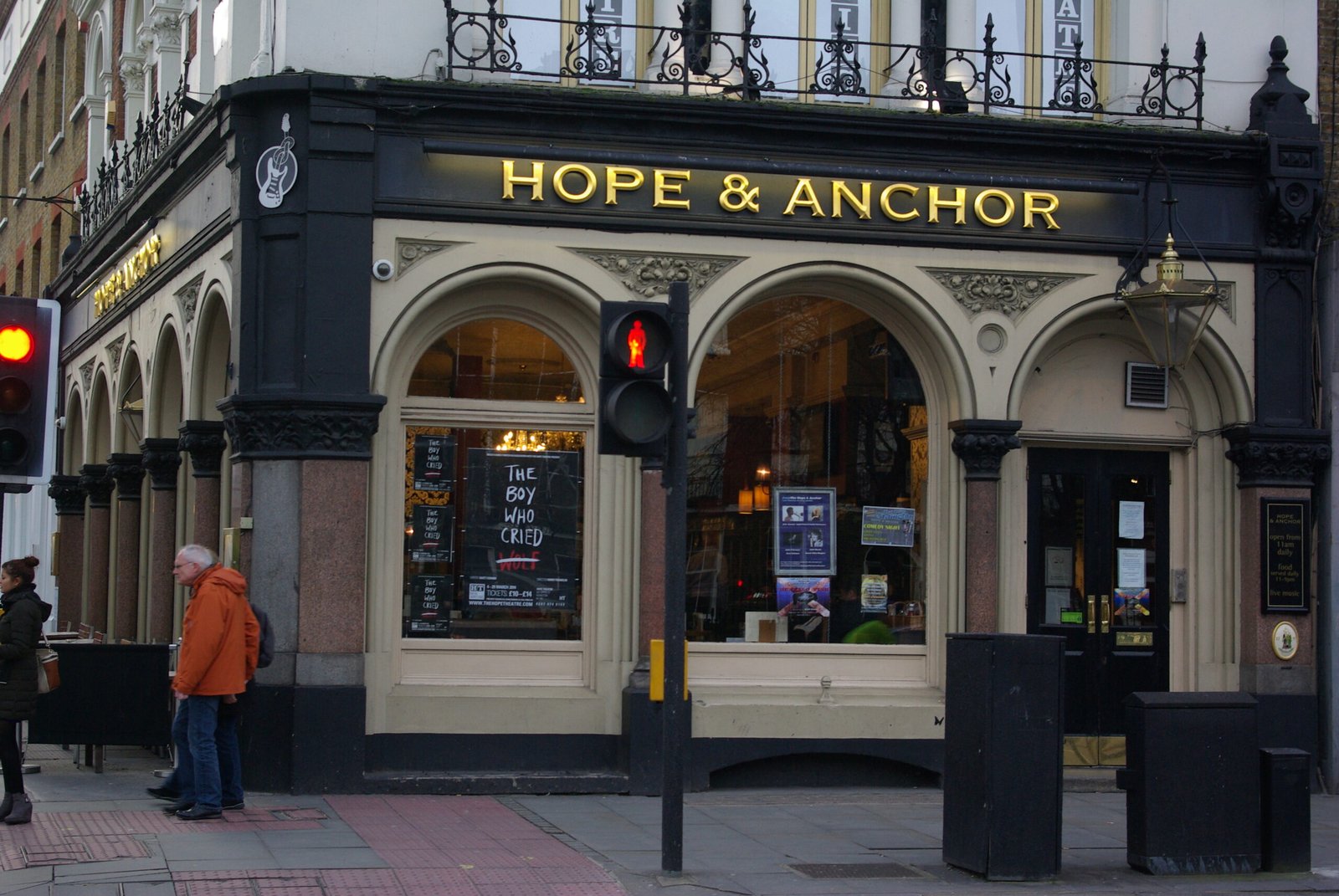
One of the capital’s most storied music pubs is looking for someone new to pull the pints. The Hope & Anchor on Upper Street in Islington — the Victorian corner local whose sweaty basement stage launched some of the biggest names in British rock — is being offered for tenancy by pub company Greene King.
The company is inviting applications from what it calls “an ambitious operator” to take over a venue it describes as one of London’s most iconic live entertainment pubs. The advert promises a rare opportunity spread across three characterful floors: an open-plan bar, a basement music venue with near-mythical status, and a community theatre space upstairs.
Whoever applies will need to show they can turn the room’s legendary reputation into revenue. The listing says the ideal candidate will have a background in music venues, late-night hospitality or entertainment-led businesses, and will have to prove they can pack the calendar with live events while using creative marketing and social media to build audiences. “If you’re passionate about entertainment, community and creating unforgettable nights out, the Hope & Anchor could be your perfect next venture,” the advert adds.
Whoever takes it on will inherit a remarkable legacy. Built in 1880, the Upper Street pub began putting on jazz and blues nights in its basement in the early 1970s before becoming what many now call “ground zero” for punk and new wave, when crowds of up to 200 would squeeze into the sweaty room below the bar.
The roll call of acts who played early — and in some cases career-defining — gigs there reads like a hall of fame: Dire Straits, The Clash, Madness and U2, alongside The Stranglers, The Cure, Joy Division, The Police, The Jam and Elvis Costello. Back then, punters paid between 30p and 75p for a ticket, and bands hauled their gear down a chute that had originally been built for beer barrels.
Some of those nights have passed into music folklore. Elvis Costello played his first paid London show there on 27 July 1977. The Police played one of their earliest London gigs on 23 February 1978, while still unsigned. Later that year The Cure and Joy Division shared a bill in front of just 30 people. And on 4 December 1979, a young Dublin band called U2 played their first-ever British show — billed, famously, as “V2” — to an audience of nine.
It’s the kind of record that makes the Hope & Anchor more than a pub with a stage. In the 1970s it functioned as an unofficial A&R department for British music: landlords Fred Grainger and Dave Robinson — who would go on to co-found Stiff Records — turned the basement into a testing ground where bands could fail in front of a small crowd, sharpen up and come back fighting. The Damned filmed the video for “New Rose” down there in 1976; Madness shot the video for “One Step Beyond” in the same room; and the pub even popped up in the film Breaking Glass. Before they were famous, Shane McGowan, Annie Lennox and Gary Kemp all played the room too, while The Stranglers held a Sunday night residency that famously drew “one man and a dog” on quieter evenings.
The venue’s story is also a story of Islington itself. It lost its music licence in 1985 and stood empty for months before being briefly squatted; by 1988 it had been converted into a wine bar as the area gentrified, its Victorian interior stripped out. Historic England granted the building Grade II listed status in 1994, protecting the façade. Live music finally returned in 1996 with the launch of “Sausage Factory” Friday nights — 15 bands across three floors on opening night — and the legend started building again. Keane made their debut at the pub, and The Libertines packed the basement so tightly that Pete Doherty is rumoured to have escaped through a toilet window. James Smith took over as general manager in 2011 and led a revival of its grassroots music scene; the Hope Theatre opened on the first floor in 2013; and Birdy filmed her cover of “Skinny Love” in the basement in 2014. A major refit in 2016 brought a new PA system, air conditioning, a bigger stage and upgraded lighting, with the stage restored to its 1970s position.
That history gives the search for a new landlord a weight that goes beyond one tenancy. Grassroots music venues across the capital have faced real pressure in recent years, from soaring costs to licensing headaches, and Islington is unusually rich in live music rooms — the Union Chapel, Islington Assembly Hall, the O2 Academy and The Garage are all within the borough. But the Hope & Anchor plays a different role from all of them: the small, sweaty room at the bottom of the ladder, where a band can play to nine people on a Tuesday night and end up headlining festivals a decade later. For the borough’s night-time economy, keeping that kind of room alive matters more than keeping another bar open.
For now, though, the advert frames the opportunity in upbeat terms: three floors, a built-in audience of gig-goers, and one of the most storied stages in London music. Interested operators can apply through Greene King’s pub partners website.