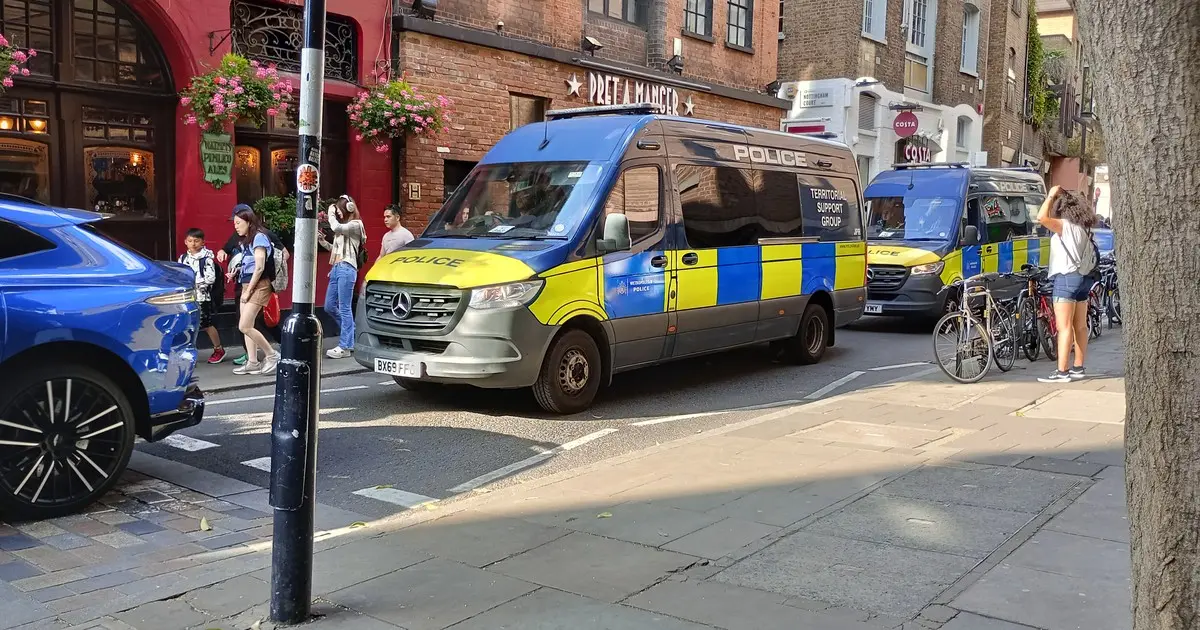
Westminster has recorded more theft offences than any other part of London, according to new figures that lay bare the capital’s crime map.
The borough saw 5,498 theft offences recorded in the 12 months ending September 2026, putting it comfortably ahead of every other area in the Metropolitan Police data. Lambeth followed with 3,489, narrowly ahead of Southwark on 3,725 and Newham on 3,470.
The numbers were crunched by borough — and when adjusted for population, Westminster’s dominance becomes even starker. At 21.1 offences per 1,000 residents, its theft rate was far higher than anywhere else in London. Kensington and Chelsea came next at 13.8 per 1,000, followed by Camden at 12.3, Islington at 11.8, Southwark at 11.6 and Tower Hamlets at 10.9.
At the other end of the table, the picture is very different. Richmond upon Thames recorded just 4.9 theft offences per 1,000 people. Bexley and Harrow each recorded 5.3, while Kingston upon Thames, Merton and Sutton all came in at 5.4.
Why Westminster tops the table
The figures cover every theft offence logged by the Met — from shoplifting to burglary to the phone snatching that has become one of London’s most visible crime problems. Westminster’s position at the top is hardly surprising: the borough contains the West End, Oxford Street, major shopping districts, transport hubs and some of the capital’s busiest tourist areas, all of which draw crowds — and, inevitably, thieves.
The data does not, by itself, explain why crime levels differ between boroughs. But the pattern is familiar: areas with the most footfall, the most shops and the most visitors tend to generate the most theft reports.
The full borough ranking for total theft offences reads: Westminster 5,498; Southwark 3,725; Lambeth 3,489; Newham 3,470; Tower Hamlets 3,462; Camden 3,040; Croydon 2,925; Ealing 2,801; Islington 2,799; Brent 2,777; Hackney 2,739.
A slight fall across London
There is some good news in the figures. Despite the high totals in the busiest boroughs, the London-wide theft total fell by 1.8 per cent compared with the previous 12-month period — suggesting the trend, at least at the moment, is moving in the right direction.
The Met has been targeting theft hard in recent months. On 8 October, officers stopped a man on an e-bike and found him with 11 mobile phones and rolls of tin foil. And on 28 September, a gang behind what police called the UK’s largest mobile smuggling network — which trafficked up to 40,000 stolen phones to China — was jailed.
Phone theft in particular has driven much of the public anxiety around London crime, with snatch thefts from pedestrians becoming a common sight in central London. The Met has responded with dedicated operations, plain-clothes patrols and crackdowns on the international networks that buy up stolen handsets.
What the rates tell us
The per-population rates add an important dimension to the raw numbers. A borough like Westminster will always generate large totals because of the millions of people who pass through it every day but don’t live there — its resident population is far smaller than the number of people actually on its streets.
Even so, the gap between Westminster’s 21.1 per 1,000 and the next-highest rate of 13.8 is substantial. Kensington and Chelsea, which also contains some of London’s most visited shopping streets and tourist attractions, sits well clear of the rest of the pack too.
For residents of quieter outer-London boroughs, the figures confirm what many already feel: theft is overwhelmingly a central-London problem. Richmond’s rate of 4.9 per 1,000 is less than a quarter of Westminster’s — a reminder of just how uneven the capital’s crime map really is.
London Streets has been covering crime figures across south-west London and the Brixton Tube station arrests this week.