


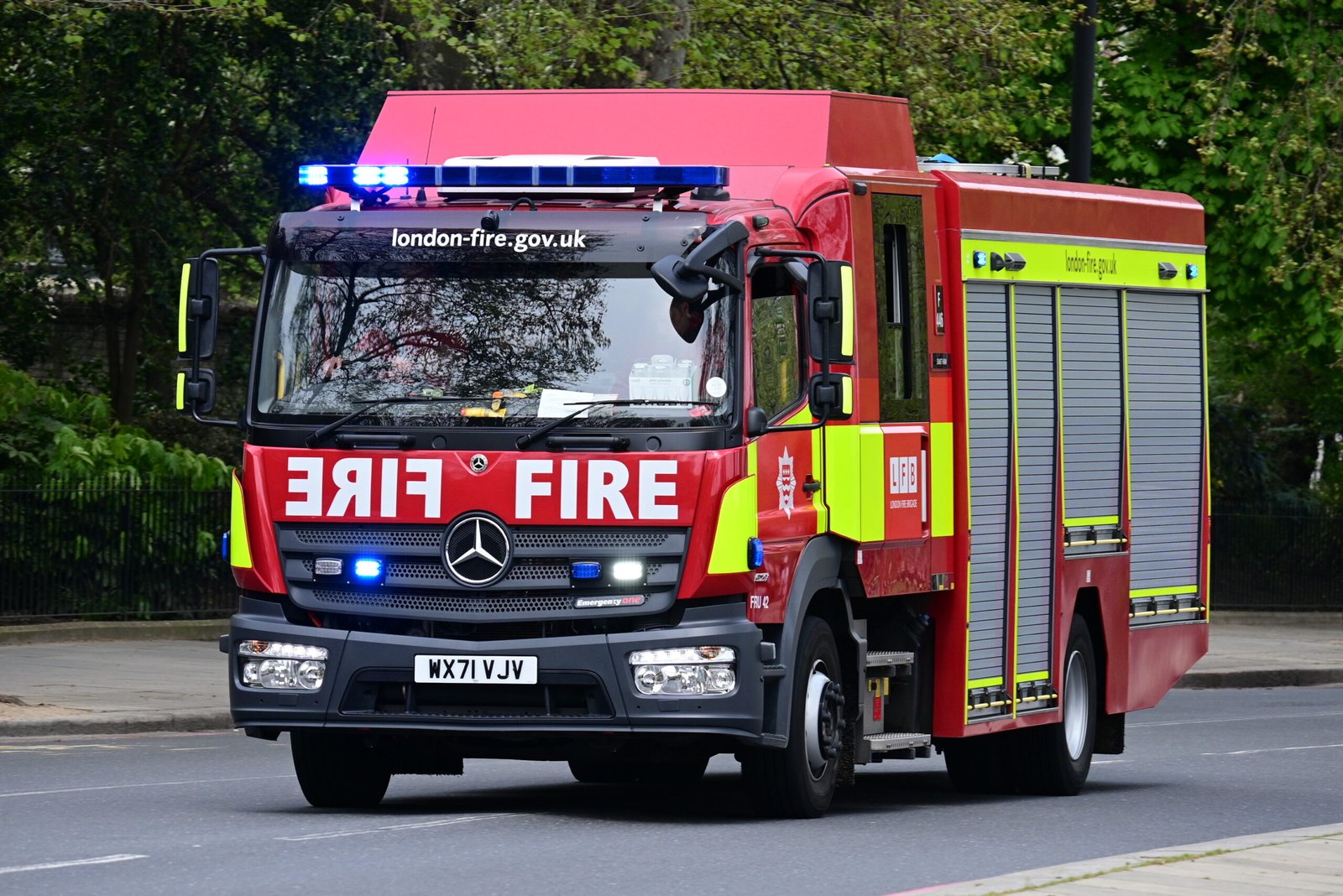
Firefighters were forced to cut the roof from a car after a serious crash on the North Circular in north London, in a dramatic rescue that shut one of the capital’s busiest roads in both directions.
The collision happened at the junction of the North Circular and Woodheyes Road, a short distance from Brent Cross, where crews found a vehicle so badly damaged that its occupant could not be reached through the doors.
Specialist teams from the London Fire Brigade’s Fire Rescue Unit used hydraulic cutting equipment to slice through the pillars of a blue Nissan Juke, removing the entire roof to create a safe opening for paramedics to work through.
Witnesses at the scene said a pregnant woman was seriously injured in the crash, although the full extent of her injuries has not been officially confirmed.
Photographs taken at the scene show firefighters in high-visibility clothing gathered around the stricken car, its roof and structural pillars completely removed to expose the interior.
The North Circular was closed in both directions while the rescue operation continued, with congestion building back towards Brent Cross and drivers across the area facing long delays.
Why crews cut the roof off a car
Removing a car’s roof is one of the most involved techniques in a firefighter’s toolkit, and it is only deployed when there is no safer way to reach the casualty inside.
The procedure, sometimes called a roof removal or “roof flap”, begins with firefighters stabilising the vehicle so it cannot shift while they work. Hydraulic cutters and spreaders — the tools often nicknamed the “jaws of life” — are then used to sever the A, B and C pillars on both sides of the car.
The windscreen is taken out, and the roof is folded or lifted clear, opening up the entire top of the passenger compartment. That gives paramedics the space to treat the patient in place and then lift them out horizontally on a spinal board.
It is the method of choice when a casualty may have spinal injuries and must be moved as little as possible, or when the doors are too badly deformed to be forced open.
The operation is carried out inch by inch in close coordination with ambulance crews, who direct the extrication around the patient’s injuries. The London Fire Brigade’s Fire Rescue Units are specialist heavy-rescue teams trained for complex entrapments, carrying cutting, lifting and stabilisation equipment that goes well beyond a standard fire engine’s kit.
A road with a troubled safety record
The North Circular — the A406 — has seen a string of serious collisions in recent weeks, underlining its reputation as one of the busiest and most demanding orbital routes in the capital.
The section around Brent Cross and Woodheyes Road is a known pressure point, where local traffic joining and leaving the carriageway mixes with fast-moving through traffic heading between the M1 and east London.
Road safety campaigners have long described the A406 as one of London’s most crash-prone corridors, and its junctions are regularly the focus of demands for clearer lane markings, better crossings and calmer speeds.
Each serious collision on the route ripples quickly across the network: with few realistic alternatives for orbital journeys, a single closure can snarl traffic from Barnet to Hanger Lane.
Travel disruption
With the carriageway shut in both directions, queues stretched back towards Brent Cross on Saturday morning, and drivers were urged to avoid the area and seek alternative routes.
The closure piled pressure onto surrounding roads through Hendon and Cricklewood, with congestion building as diverted traffic filtered through local streets.
It made for a difficult morning for London travellers: the Metropolitan line was also part-suspended after a trespasser on the tracks near Chalfont & Latimer brought trains to a standstill.
Once the casualty is freed, the road typically stays closed while police collision investigators examine the scene and recovery crews clear the carriageway — a process that can take several hours after a serious crash.
Emergency services were contacted for further information about the crash.