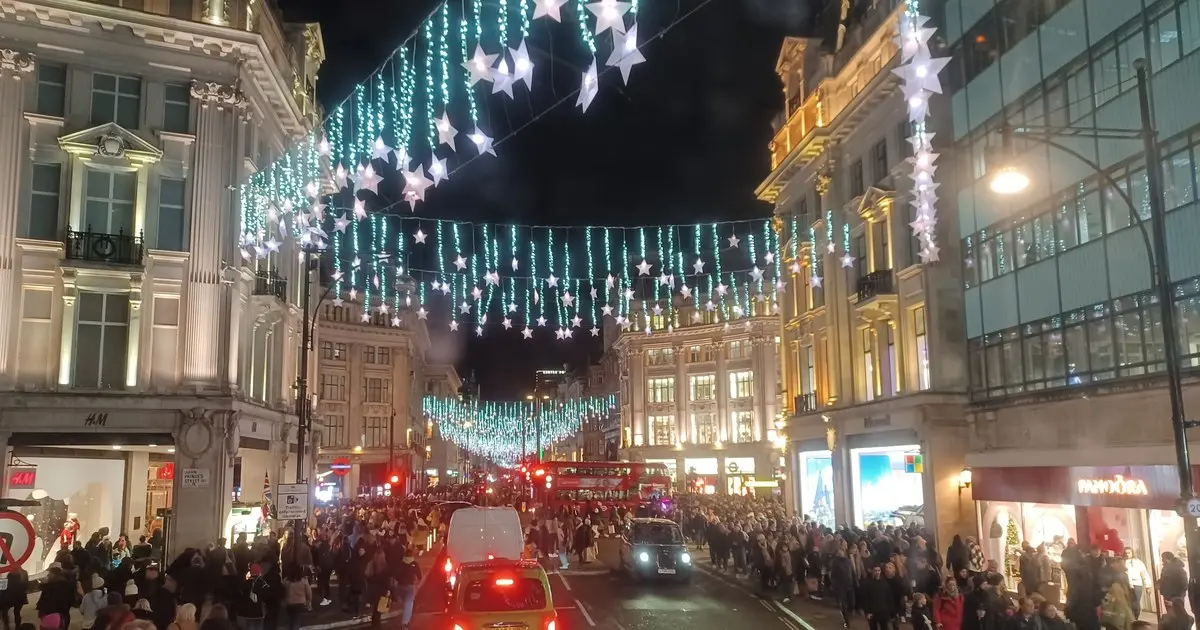
Christmas shoppers on Oxford Street are set to have their faces scanned by permanent live facial recognition cameras, under Metropolitan Police plans to install fixed cameras in the West End and Soho in time for the festive season.
The move would make the capital’s busiest shopping streets among the first places in the country to have permanent, always-on facial recognition surveillance — a major escalation of the Met’s use of the controversial technology.
The Met said it plans to introduce fixed live facial recognition (LFR) cameras in the West End and Soho, which have some of the highest crime rates in London. The cameras, expected to be installed in December, could be attached to street furniture such as lampposts.
They will scan the faces of passers-by and compare them against a watchlist of wanted suspects, alerting officers to anyone flagged on the list.
A Met Police spokesperson said: “Live, facial recognition is an important tool which is helping us keep London safe.”
“Considering this success, the public would rightly expect us to look at how we can use technology to keep the busiest parts of our capital safe.”
“It is important to note that static systems are only turned on when officers are present on the ground, and signs will make it clear to the public that a deployment is taking place.”
Croydon pilot cut crime by 10.5 per cent
The West End plan follows a six-month pilot of static LFR cameras in Croydon, which ran from October 2025 to March 2026 and which the Met hailed as a success.
According to the Met’s own account of the pilot, officers made 173 arrests during 24 operations — the equivalent of one arrest every 35 minutes. Crime in the area fell by 10.5 per cent compared with the same period the previous year, with the biggest drop — 21 per cent — in violence against women and girls offences.
Those arrested included people wanted for kidnap, rape and serious sexual assault. More than 470,000 people walked past the cameras during the pilot, with just one false alert — and the Met says no one has ever been arrested as a result of a false alert from LFR.
The cameras were mounted on lampposts at the north and south ends of Croydon’s high street, using bespoke watchlists drawn up no more than 24 hours before each deployment and deleted immediately afterwards.
Lindsey Chiswick, the national and Met lead for live facial recognition, said at the time: “These results show why live facial recognition is such a powerful tool when it’s used carefully, openly and in the right places.”
The Met has been steadily widening the technology’s footprint. London Streets reported in September that Stratford station had been chosen for a live facial recognition trial, and the cameras have also started to be deployed at Tube stations across the capital.
West End chosen for its crime levels
Oxford Street is one of the world’s busiest shopping areas, with around 500,000 visitors passing through each day — and the West End’s crowds have long made it a hotspot for theft, robbery and disorder.
Westminster, which covers the West End and Soho, has the highest violent crime rate of any London borough, according to recent borough-level figures. The Met said the West End and Soho were selected precisely because they have some of the highest crime rates in London.
The festive season is traditionally one of the most demanding periods for the force. The Met recently ran a fortnight-long retail crime crackdown that saw 42 arrests and 11 shops shut, and officers targeted shoplifting teams across shopping districts — a campaign the force is likely to repeat over Christmas.
Civil liberties groups urge a pause
The permanent rollout has drawn sharp criticism from human rights campaigners, who argue the technology is being expanded before Parliament has set the legal rules.
Akiko Hart, director of human rights group Liberty, said the plans would mean “thousands of Christmas shoppers will have their faces scanned by this unregulated surveillance technology without being given a choice”.
She pointed out that a public consultation on facial recognition closed in February, but the Government has yet to publish its response. The Government launched the consultation in December 2025 to develop a legal framework for law enforcement use of biometrics and facial recognition, with the Home Office expected to respond later this Parliamentary session.
“This lack of transparency damages public trust and, until clear laws, proper safeguards and independent oversight are in place, this significant rollout should be paused,” Ms Hart said.
A political fault line
The debate has taken on a political edge. Metropolitan Police Commissioner Sir Mark Rowley has described LFR as “one of the most revolutionary technology advances in policing in recent years”, and the Met says it has arrested more than 2,000 people using the technology since the start of 2024.
Conservative leader Kemi Badenoch has voiced support for wider use of LFR, telling the Police Federation’s annual conference: “We will expand live, facial recognition so that instead of spending hours and hours crawling through CCTV, you’ll get a match in seconds.”
The Met’s broader use of intelligence-led operations has delivered high-profile results in recent months, including the dismantling of a criminal network supplying blank-firing firearms across London.
With around half a million people visiting Oxford Street each day, the fixed cameras could become a flashpoint in the ongoing national discussion about privacy, policing and public safety — and a test case for how far permanent facial recognition spreads beyond the capital.