


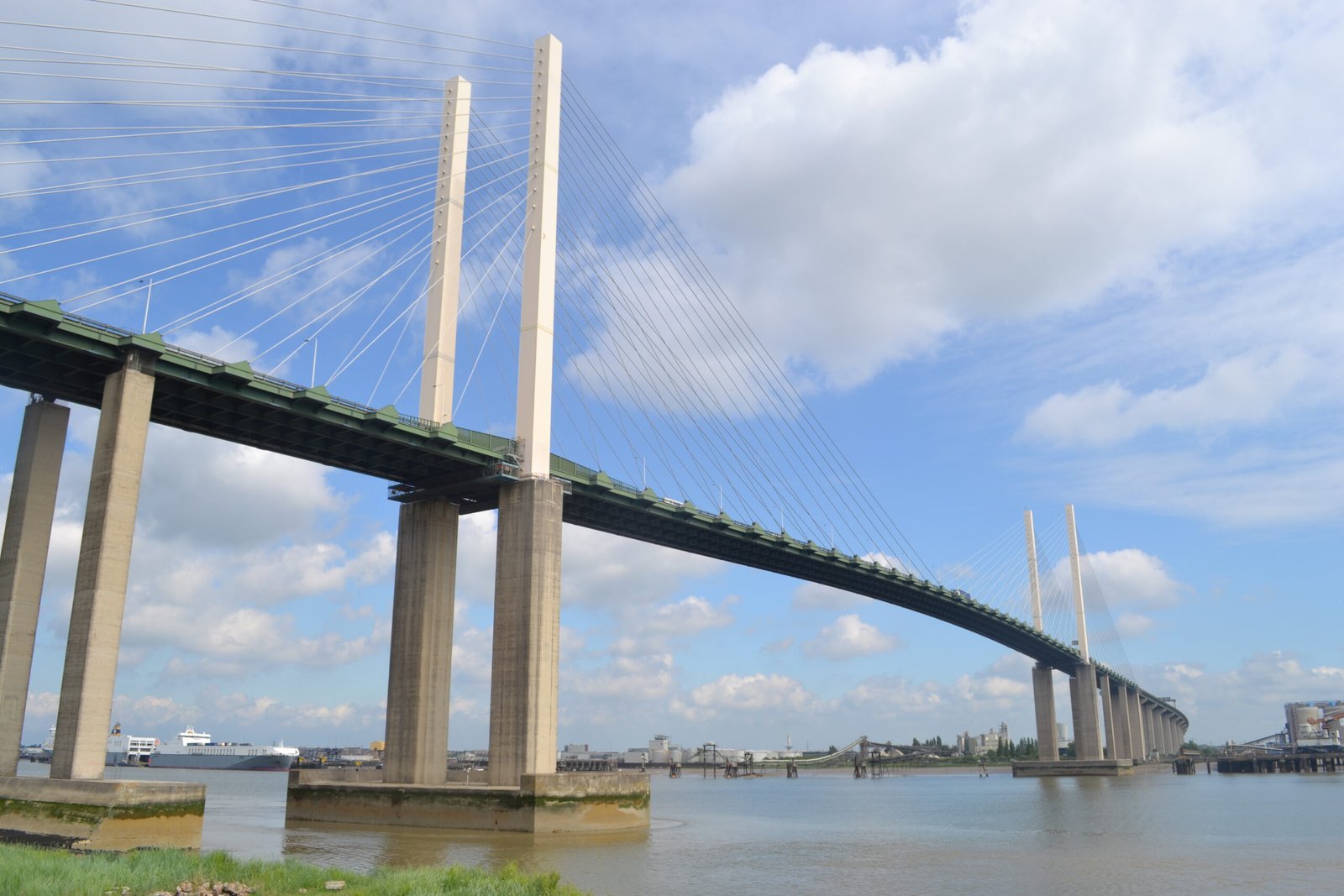
Anyone who claims to have driven a complete lap of the M25 is wrong — because Britain’s most famous motorway isn’t actually a full circle. For one short stretch over the Thames, the M25 simply ceases to exist.
The gap is the Dartford Crossing, the fixed link carrying traffic between Kent and Essex. Officially, that section is not the M25 at all: it is the A282, which meets the motorway at both ends and takes drivers over — or under — the river.
According to National Highways, the A282 connects directly with the M25 at either side. Southbound traffic crosses on the 137-metre-high Queen Elizabeth II Bridge, while northbound vehicles pass beneath the Thames through the two Dartford tunnels.
On the Kent side the change happens around junction 2 near Dartford, with the A282 running through its own junctions 1a and 1b before the river. On the far bank it becomes the M25 again around junction 31 near Thurrock in Essex. For most drivers the switch is seamless — the signs change, but the road feels like one continuous motorway.
So why the quirk? Put simply, the crossing is older than the motorway. The first Dartford Tunnel opened in 1963 and the second followed in 1980, while the M25 was built in stages and only completed as a circular route in 1986. Rather than redesignating the existing road, the motorway was simply linked into it — government papers from 1978 already referred to the Dartford stretch as the A282, then known as the South Orbital Road. The Queen Elizabeth II Bridge came later, opening in 1991 to cope with growing traffic.
The A-road status has real consequences. National Highways consistently labels the crossing as the A282, including in closure and roadworks announcements, and motorway regulations do not automatically apply in the same way. That matters because it is the only fixed road crossing of the Thames east of Greater London — keeping it an all-purpose road leaves a route open for traffic that would be barred from a motorway. Further upstream, drivers using the Silvertown and Blackwall tunnels have just seen tolls rise.
It is also one of the busiest short stretches in the country. National Highways says more than 50 million vehicles use the crossing each year. It was designed for around 135,000 vehicles a day but now averages 150,000, with the busiest days topping 180,000 — and about 40 per cent of daily traffic is freight or HGVs.
The result is a motorway with a missing piece. So the next time someone brags about lapping London’s orbital, you can tell them: technically, part of the journey was on an A-road.