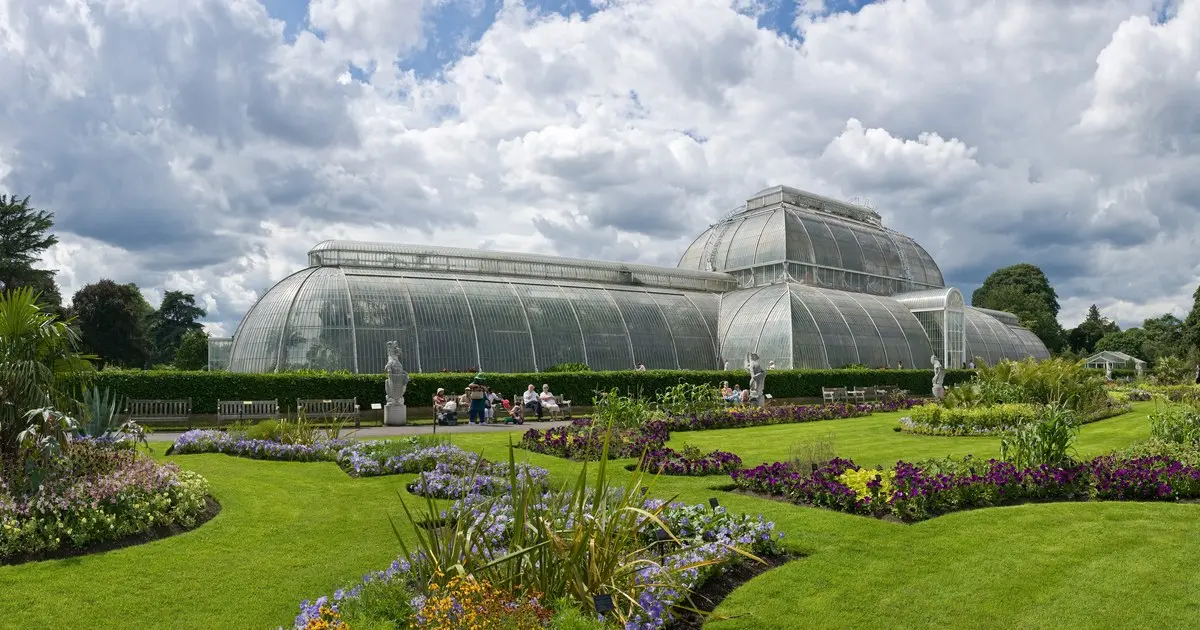
Kew Gardens has launched a £1 million public appeal to help save its iconic Palm House, the 180-year-old Victorian glasshouse that has become one of London’s most recognisable landmarks.
The appeal, fronted by Dame Judi Dench, will contribute toward a £66 million restoration project that will see the historic building close for up to four years while it undergoes a complete overhaul.
Why the Palm House needs saving
After nearly two centuries, the Palm House is showing its age. Its white-painted ironwork is now marred by red rust, and the thousands of glass panes are under pressure from the mature palms and ferns growing within. What was once a marvel of Victorian engineering now needs a robust, modern restoration to survive.
The planned work is extensive: 16,000 new panes of glass will be installed, the antique iron structure will be restored, and the building will be future-proofed with a net-zero energy system. The old gas boilers will be replaced with a fully electrified air-source and water-source heat pump system, alongside improved insulation and new rainwater and heat storage.
Accessibility will also be transformed. The current structure requires visitors to climb delicate spiral staircases — beautiful, but impossible for many. The restoration will open the building up to everyone.
Dame Judi Dench leads the appeal
Dame Judi Dench, the official ambassador for the Palm House, is urging the public to donate. She called the building “one of Britain’s great wonders” and described supporting the renovation as “an investment in both our heritage and our future.”
“It is an irreplaceable symbol of beauty, discovery, and hope,” she said.
Donors can contribute specific sums or sponsor a pane of glass or a tropical plant species, receiving a digital gift certificate — pitched as a unique present for plant lovers.
What happens to the plants?
The Palm House is home to more than 1,000 plants, and moving them is already underway. Kew’s horticulturalists have been relocating specimens to new homes since spring 2025, and by February 2027 every plant will have been moved out.
Some of the most precious specimens will be temporarily housed elsewhere in the gardens — including the Eastern Cape giant cycad, believed to be the world’s oldest potted plant, which will take up residence in the Temperate House until the Palm House reopens.
When will it close?
Visitors can still see the Palm House — including its increasingly empty interior — until next autumn. The building is scheduled to close in autumn 2027, when scaffolding will go up and restoration work begins in earnest. The closure is expected to last three to four years.
It is a significant closure for one of Kew’s star attractions, but the gardens’ team argues it is essential. Without this intervention, one of Britain’s great Victorian glasshouses would continue to deteriorate beyond the point of rescue.
A symbol of Kew
The Palm House has stood at the heart of the Royal Botanic Gardens since the 1840s, a cathedral of glass and iron that announced Britain’s botanical ambitions to the world. Generations of Londoners have walked beneath its soaring roof, from Victorian plant hunters to modern-day school trips.
The £1 million public appeal is a chance for the public to play a direct part in its future. While the sum is a fraction of the £66 million total cost, Kew hopes it will demonstrate the depth of public affection for the building — and help secure the larger funding needed to complete the project.
London Streets has covered other major London cultural institutions and infrastructure challenges across the capital. For more on the appeal and how to donate, visit Kew’s official website.