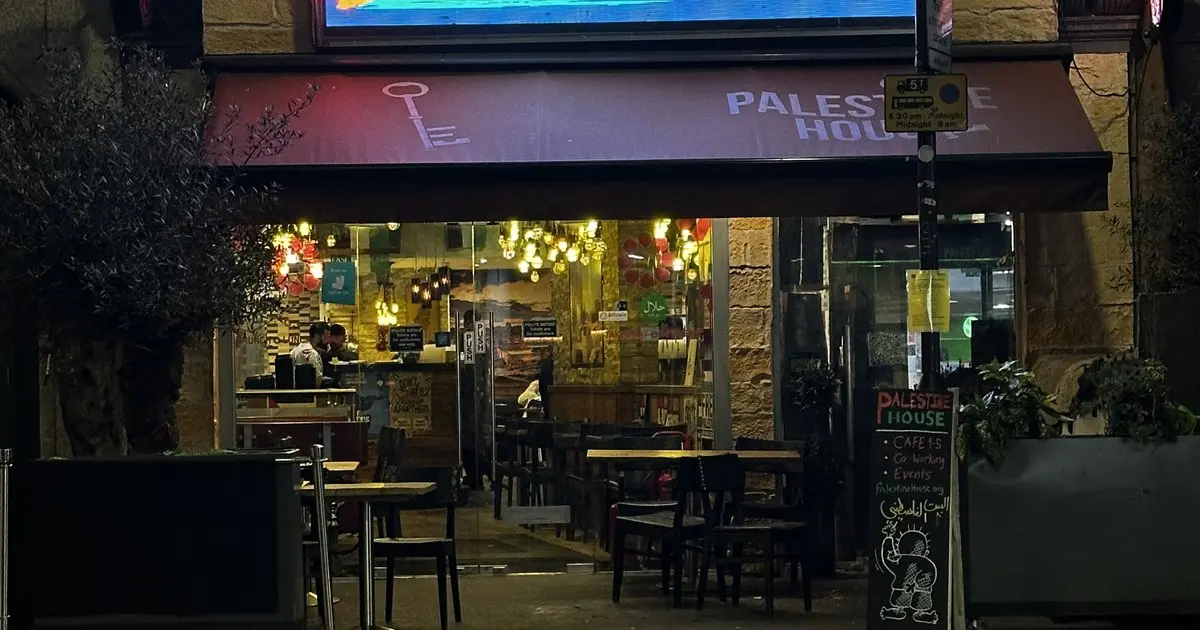
Camden Council is investigating whether a bronze statue placed on the roof of Palestine House in High Holborn was installed legally, and whether planning permission was required for it.
The statue depicts Marwan Barghouti with his handcuffed hands raised above his head, his fingers forming a V shape. It stands on the roof of Palestine House, a Palestinian cultural and community centre on High Holborn.
The council’s planning enforcement department has confirmed that an investigation into the property is underway. The investigation followed a complaint filed on Thursday by the pro-Israel British legal organisation UK Lawyers for Israel (UKLFI).
UKLFI argues that neither the statue nor its base appears in the building plans that were approved in July 2025. The organisation also notes that the property sits in a conservation area. That is UKLFI’s argument; it is not a finding by the council, and the council has not said what its investigation will conclude.
The statue had previously appeared in June, when activists campaigning for Barghouti’s release attempted to erect it in Parliament Square. Police prevented that installation and the statue was removed, before it later found a home on the rooftop in High Holborn.
Palestine House has faced planning scrutiny before. Earlier attention concerned Palestinian flags near the building, a Gaza Cola advertisement, and an illuminated sign. Each of those matters was examined separately, and none of them is the subject of the current investigation.
Barghouti, 66, was convicted in Israel in 2004 of five murders and sentenced to five life terms plus 40 years. That conviction record is stated here as a matter of fact; it is not presented as a judgement on the statue itself, and the question now before the council is a planning one, not a criminal one.
Planning enforcement investigations of this kind generally begin by establishing the facts on the ground: what has been installed, where it sits, and what the approved plans for the building actually allow. Officers then consider whether the structure needed planning permission in the first place. In conservation areas, controls over changes to buildings are generally stricter than elsewhere, which is why the area’s status features in the complaint. Planning decisions in London often turn on exactly these kinds of detailed questions about what was approved and what was built.
What happens next is not yet known. The council has not indicated whether it will decide that permission was required, whether any retrospective application will be invited, or whether any other enforcement step will follow. No outcome should be assumed while the investigation is still open, and the statue remains in place for now.
UKLFI has also criticised the council’s handling of the matter. The council, for its part, has confirmed only that the investigation is underway, and has not commented further on the substance of the complaint.
High Holborn is one of central London’s busiest thoroughfares, and Palestine House sits among a mix of offices, shops and cultural venues. Elsewhere in Camden, the borough’s streets carry layers of history that often become part of present-day planning debates, as older buildings and newer uses sit side by side.
The distinction matters for anyone following the case. What is confirmed is narrow: a complaint was filed on Thursday, and the council’s planning enforcement department has confirmed that an investigation is underway. What is argued, by UKLFI, is that the statue and its base do not appear in the building plans approved in July 2025. What is not yet established is whether the council agrees with that reading of the plans, or what action, if any, it will take as a result.
For now, the position is straightforward: a complaint has been made, an investigation has been confirmed, and the central planning question — whether the rooftop statue needed permission — remains unanswered. Until the council completes its work, the arguments on either side remain just that: arguments, not findings.