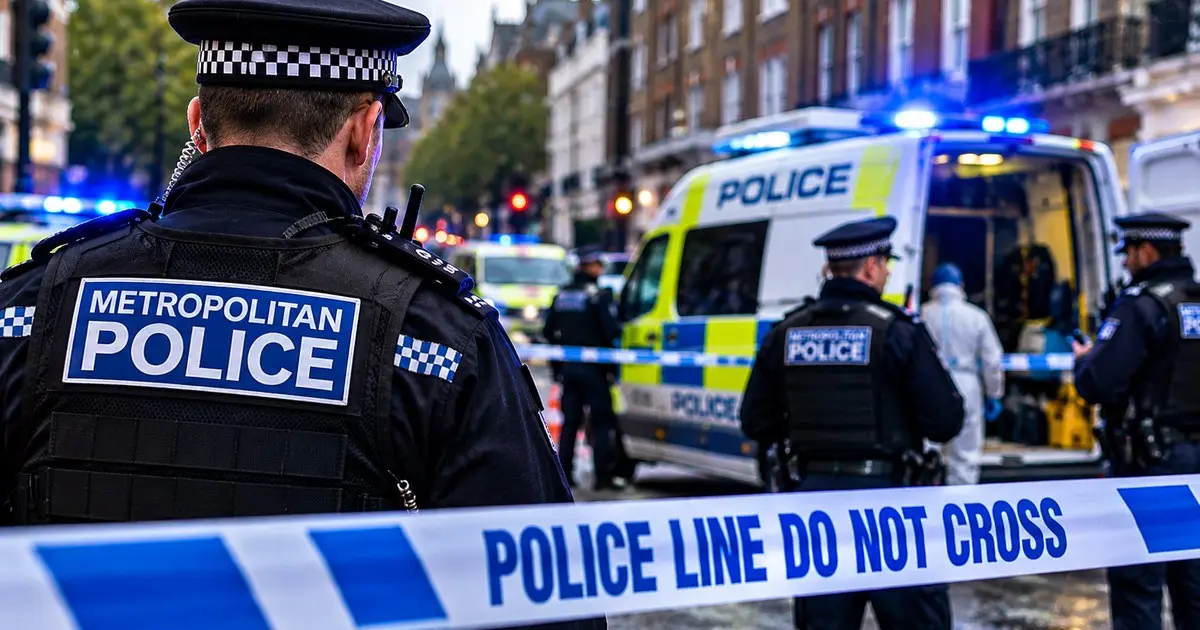
Police were given enhanced stop-and-search powers across four north-west London neighbourhoods overnight after a zombie knife and a suspected gun were found in Harlesden.
The Section 60 order covered Harlesden, Stonebridge, Kensal Green and Roundwood. It ran from 10.40pm on Tuesday 28 October until 6am on Wednesday 29 October, and has now ended.
It followed a report to the Metropolitan Police at around 9.40pm on Tuesday, alerting officers to the discovery of a knife on Tavistock Road, Harlesden. Officers attended and recovered a zombie knife.
While responding to that report, officers came across a teenage boy suffering head injuries. He was taken to hospital, where his condition was described as neither life-threatening nor life-changing.
Further searches of the area were then carried out, and a suspected gun was recovered. Tests are under way to establish whether the object is a gun, as suspected.
As a result of those discoveries, police were given additional powers to carry out stop and searches in the specified areas under the Section 60 order.
What a Section 60 order means
Section 60 of the Criminal Justice and Public Order Act 1994 allows a senior officer to authorise stop and search without individual reasonable grounds in a defined area for a limited period, where it is believed serious violence may take place or weapons are being carried. It differs from ordinary stop and search, which normally requires an officer to have reasonable grounds to suspect a person is carrying something unlawful.
Orders are time-limited and geographically bounded: officers may only use the power within the named area and while the authorisation is in force. In this case that meant the four named neighbourhoods between 10.40pm and 6am.
The power is a preventive tool rather than a response to a single individual. It does not, on its own, mean that anyone stopped is suspected of a specific offence, and it does not change the rules on arrest, which still require grounds.
Police response
Detective Sergeant Tony Bellis said: “I understand the concern that this incident has caused the local community.”
He added: “Detectives are carrying out a thorough investigation to establish the exact circumstances.”
“We have increased patrols in the area as part of our Autumn Nights operation to provide community reassurance during this period,” he said.
No arrests have been reported in connection with the incident. The investigation into the exact circumstances continues, and tests on the suspected gun are ongoing.
The order itself was a follow-up to the Harlesden incident on Tuesday evening, in which a teenager was taken to hospital after a zombie knife and a suspected gun were found. Readers can find the full account of that incident there.
Other recent court and police cases covered by London Streets include a double stabbing in Plaistow, where two people were taken to hospital, and a man charged over the death of a pedestrian in a 2023 Balham crash.