


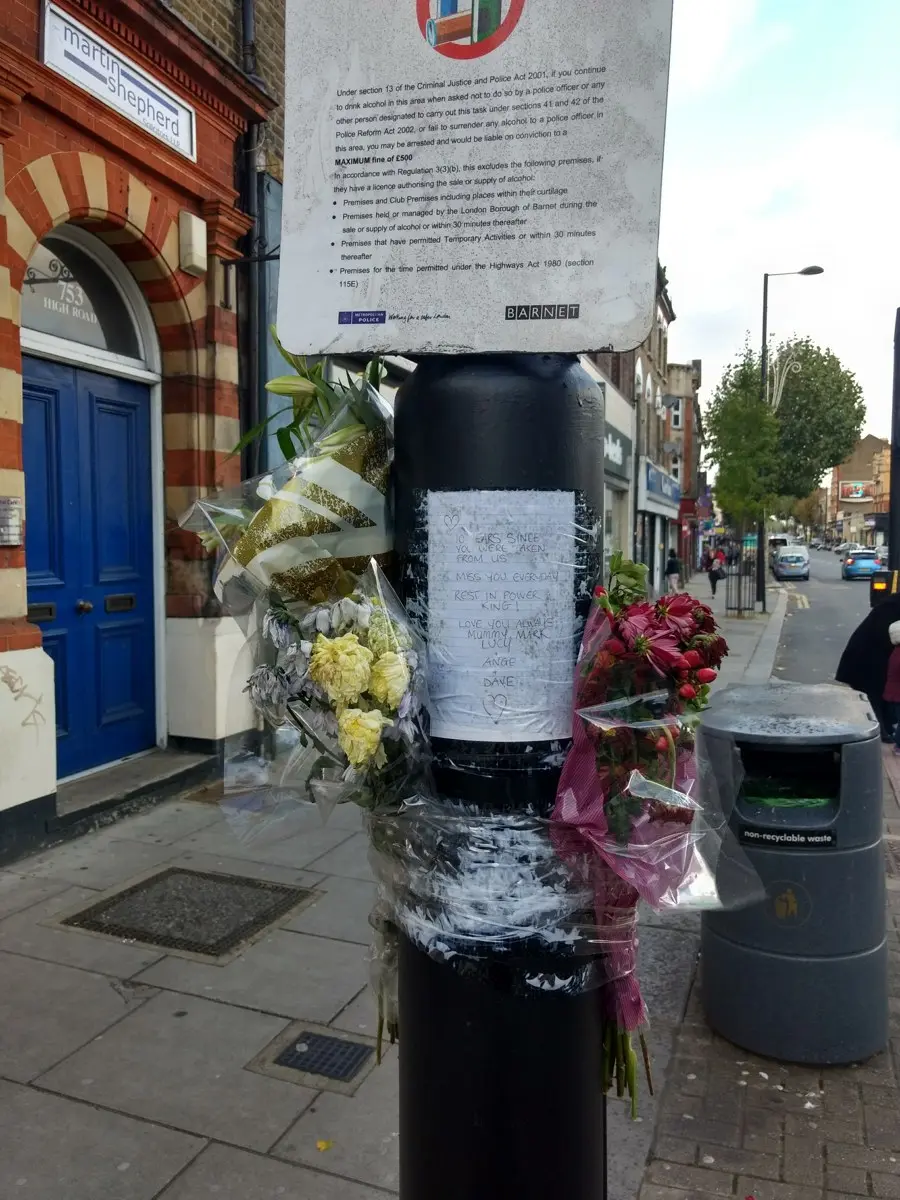
A grieving mother from North Finchley has spoken of her heartbreak after the roadside memorial to her teenage son — killed in a hit-and-run almost a decade ago — was repeatedly targeted by vandals.
Joanne O’Keefe, 49, has been left devastated by the repeated destruction of tributes to her son Alfie, who was 16 when he died after being struck by a car on Buxted Road in November 2016.
She is now hoping to raise £2,000 for a burial plot and headstone, in a bid to give Alfie a safe and permanent resting place that cannot be touched.
“I never, ever, thought I’d make the decision for Alfie to go into the cemetery, never,” she said. “My thing was he would stay home, when I pass we would go together.
“I feel like it’s time for Alfie to be put somewhere to rest, where no-one can touch it.
“It’s sacred, no-one can go near him, no-one can damage him any more.”
A decade of grief on Buxted Road
Alfie was killed on Buxted Road in November 2016 when Ali Bahramzadeh, an unlicensed and uninsured learner driver, failed to give way and struck his moped at a mini roundabout. The impact knocked the 16-year-old 36 feet from his moped.
Bahramzadeh, who had taken his mother’s car without permission, failed to stop at the scene. He was jailed for one year in 2018 and banned from driving for two-and-a-half years following his release.
Ever since her son’s death, Ms O’Keefe has tended a memorial on the road where he died. After nearby residents sold their property, she moved the tribute to a bollard so it could remain close to the spot where Alfie lost his life.
Three years of attacks on the tribute
But in 2023, 2024 and again in 2025, the memorial was vandalised.
In 2023 it was moved from a fence to a utility box and the flowers were thrown to the ground. In 2024, Alfie’s photograph was taken from the scene.
“You can see it’s a memorial, clearly,” Ms O’Keefe said. “Why would you take something that’s so sacred to someone else?
“I don’t understand, I could never understand it.”
The wider pain of desecrated memorials
Roadside tributes — flowers, photographs, candles and handwritten notes fastened to lampposts, railings and bollards — are a familiar sight across London, marking the places where lives have been cut short on the capital’s roads. For bereaved families, tending them becomes a ritual: a way of holding on to a loved one in the place where they were last alive.
When those memorials are damaged, stolen or thrown aside, families often describe the experience as a second loss — a fresh wound torn open years after the original grief. Alfie’s death is one of a number of tragedies on London’s roads in recent years, including the suspected hit-and-run in North Pole Road, North Kensington, in which a 24-year-old cyclist died after a moped rider fled the scene.
For Ms O’Keefe, each attack on her son’s tribute has undone nearly a decade of careful remembrance — and forced her towards a decision she never wanted to make.
A permanent resting place
Ms O’Keefe is now raising money to lay Alfie to rest in a cemetery plot with a headstone — somewhere she says will be sacred, and beyond the reach of vandals. In the aftermath of fatal collisions, police witness appeals such as the recent one issued after a fatal collision in Southall often depend on the public coming forward; for the families left behind, the years that follow are measured in quiet acts of remembrance like the one Ms O’Keefe has kept for almost ten years.
She hopes a burial plot will give the family somewhere peaceful to visit and grieve — a place where Alfie can finally rest undisturbed, and where, in her words, no-one can damage him any more.