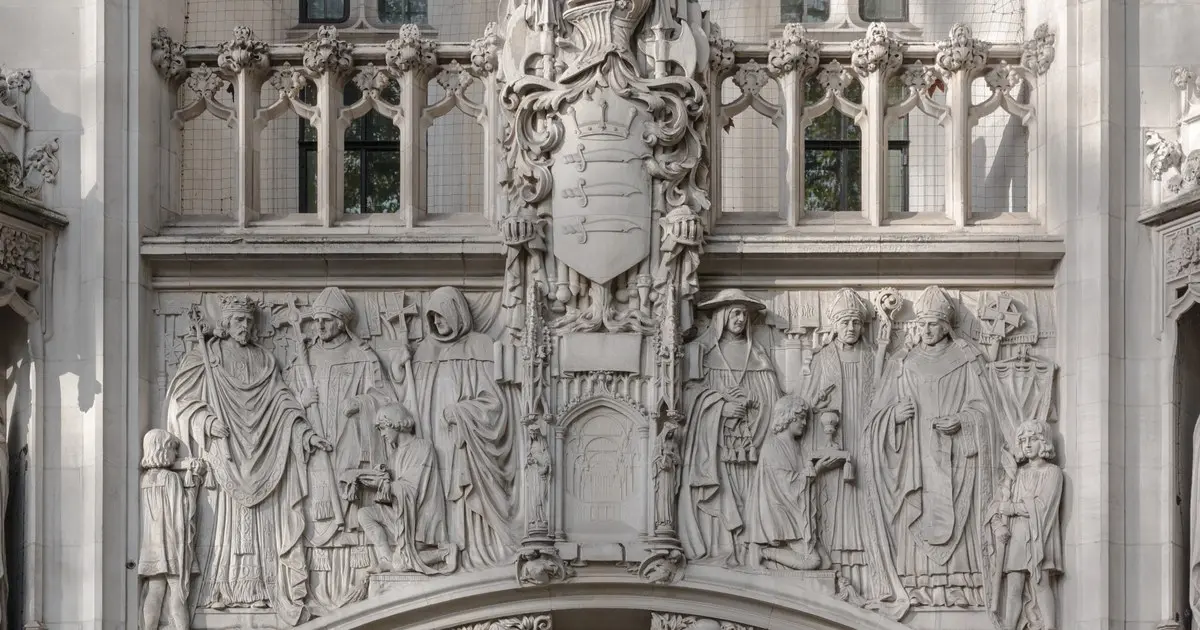
Around 25 demonstrators were arrested outside the UK Supreme Court in London on Wednesday as justices began hearing an appeal against the ban on Palestine Action.
The two-day hearing, before Lords Reed, Sales, Lloyd-Jones, Briggs and Stephens, is a challenge to the government’s decision in July 2025 to designate the direct action group as a terrorist organisation. Group co-founder Huda Ammori is seeking to quash the prohibition, arguing that the ban is disproportionate and undermines counter-terrorism law. The government argues the ban is lawful. A decision is expected at a later date, not during the hearing itself.
More than 20 demonstrators had assembled outside the central London court before the hearing began, holding placards in support of the group. Police officers were seen carrying several people away into nearby vans. Actor Alfred Enoch, who was not arrested, held up a sign reading “this is democracy not terrorism”.
Expressing support for a proscribed group is an offence under the Terrorism Act, and the court was told more than 3,000 people have been arrested since the ban came into force. Home Office statistics cited in coverage put the figure at more than 3,600 arrests linked to support for Palestine Action between proscription in July 2025 and this June — more than a third of all terrorism arrests in Britain since 9/11.
Wednesday’s arrests are separate from the protest outside the US embassy last weekend, at which more than 300 people were detained. With both sets of arrests counted, the total number of people arrested in connection with support for the group now exceeds 4,000 — though any resulting charges could be dropped if the ban is overturned.
The legal history matters to the appeal. The High Court initially ruled the ban unlawful, but the Court of Appeal overturned that decision in June. Lawyers for Ms Ammori told the court that, at the time the group was proscribed, government officials had assessed that just three of 385 actions carried out over five years had met the definition of terrorism.
Amnesty International UK responded to Wednesday’s arrests by urging the government to end the proscription, calling the arrests of people peacefully holding placards “a grim” sight.
What happens next depends on the judgment, which will follow at a later date. If the appeal succeeds, the proscription falls — and with it, the basis for the wave of arrests for expressing support. If it fails, the ban stands and the current enforcement approach continues.
Related: Harrow to review hardship support for terminally ill residents
Related: Kensington and Chelsea considers council tax rise of up to 70%