


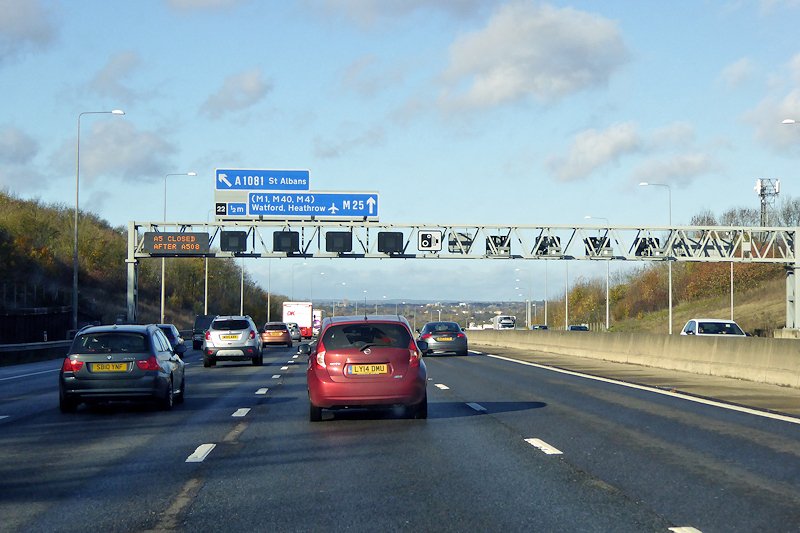
Three lanes of the M25 were closed in Essex during the Tuesday evening rush hour after a multi-vehicle crash between two Brentwood-area junctions, leaving drivers facing delays of more than 45 minutes and queues stretching for around six miles.
The collision happened on the clockwise carriageway between Junction 28 for Brentwood and Junction 29. Lanes two, three and four of the four-lane carriageway were shut, with traffic squeezed past the scene in lane one only while emergency services and recovery crews dealt with the incident.
National Highways said the closure caused severe disruption on the approach. At the height of the incident, delays were exceeding 45 minutes, with congestion building to around six miles. Earlier, as the closure first took hold, delays of more than 20 minutes and queues of around three miles had been reported.
The crash was reported during the afternoon, and the lanes remained shut through the evening peak — one of the busiest periods on what is already among the most heavily used stretches of motorway in the country. Recovery teams were sent to the scene to clear the vehicles involved, while National Highways’ regional control room issued regular updates as the situation developed.
In an update issued at 5.42pm, National Highways East confirmed that lanes two, three and four remained closed, that recovery crews were on scene, and that delays on the approach were in excess of 45 minutes with around six miles of congestion. Drivers were urged to allow extra time for their journeys and to check traffic conditions before setting out.
All lanes reopened at around 6.05pm, bringing the full closure to an end. But National Highways warned that residual delays would take time to unwind, with long queues still in place on the approach even after the carriageway was fully reopened. Motorists were told to expect disruption to continue into the evening as the backlog cleared.
The stretch of the M25 between Junctions 28 and 29 carries large volumes of traffic heading towards the Dartford Crossing and the wider Kent and Essex road network. When lanes are lost here, the effects ripple quickly across surrounding routes, including the A12, A13 and A127, as drivers look for alternatives. For planned works elsewhere on the motorway, see our guide to M25 closures this week, including every planned shutdown and diversion.
What drivers were advised to do
National Highways urged anyone heading towards the area to check live traffic information before travelling, to allow plenty of extra time, and to consider delaying non-essential journeys until the queues had eased. Drivers already caught in the congestion were told to stay in lane, keep a safe distance from the vehicle ahead, and to remain patient while recovery work continued.
Motorists were also reminded not to use closed lanes to try to beat the queues, and to watch for overhead signals and signs giving lane-by-lane instructions.
A separate incident on the M20
The M25 crash was one of several incidents affecting motorways around London on Tuesday. Separately, traffic was queueing on the M20 London-bound at the Swanley Interchange after an earlier crash and emergency repairs, with the exit slip road to the M25 anticlockwise closed for a time. The two incidents were unrelated.
What to do if you come across a motorway crash
Road safety experts advise drivers who witness or are involved in a motorway collision to slow down, switch on hazard lights and move to the left where it is safe to do so. If it is safe to stop, pull over as far left as possible, get everyone out of the vehicle and behind the safety barrier, and call 999. Drivers should never attempt to cross live lanes on foot, and should keep well clear of the carriageway while waiting for help.
Why clear-ups can take so long
Even after the vehicles involved in a crash are moved, lanes can remain closed while debris is cleared, the road surface is checked for damage, and spilt fuel or oil is dealt with. Recovery vehicles need safe working space, and traffic officers must make sure the carriageway is safe before reopening it — which is why delays often persist after the initial incident is over.