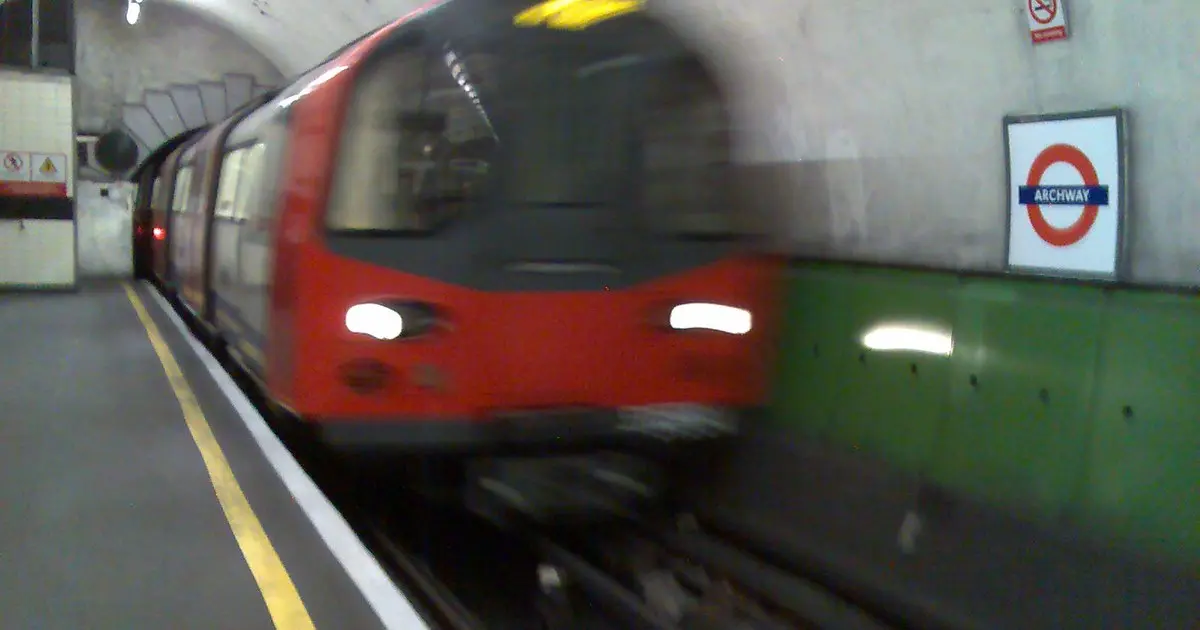
Commuters on the Victoria, Northern and Jubilee lines are encountering sound levels exceeding 100 decibels — comparable to operating a nearby power tool or chainsaw — according to transport data now raising serious questions at City Hall.
The dataset details 707 formal noise complaints registered with transport authorities over the past three years. This total includes 641 reports regarding conditions inside moving Tube carriages and 66 complaints concerning noise levels experienced on station platforms. Transport for London calculates sound exposure in carriages by taking the average noise measurement over defined periods across each distinct line.
Data published by transport officials shows that passengers on the Northern line were exposed to peak levels of up to 104 decibels during the worst recorded periods. Travellers on the Victoria and Jubilee lines experienced maximum sound levels of 102 decibels.
By contrast, the Hammersmith & City line recorded the lowest overall sound intensity. Reaching a maximum average level of 81 decibels — comparable to household appliances such as vacuum cleaners or hairdryers — the line averaged 71 decibels overall. This overall average sits 14 decibels below the mean sound levels recorded on the Victoria line.
The recorded sound levels have generated significant passenger dissatisfaction. Data for 2026 confirms that the Jubilee, Central and Northern lines accounted for the highest number of complaints concerning in-carriage sound conditions.
Elly Baker, Labour’s transport spokesperson on the London Assembly, expressed strong concern regarding the findings and called for immediate official action. Baker stated that “passengers should not have to put up with excessive noise every time they travel on the Tube”, adding that “TfL’s own data shows noise is reaching dangerous levels in parts of the network” and that “this raises serious questions about the conditions passengers are travelling in”.
Addressing the persistent nature of the issue, Baker observed that “despite years of complaints, there is still a lack of clear information about why some parts of the network are particularly noisy and what steps are being taken to address the problem”, concluding that “TfL needs to be transparent with passengers about the causes of this excessive noise and publish a clear plan to reduce it”.
The Mayor of London, Sir Sadiq Khan, confirmed in a written response to the London Assembly that there are currently no statutory legal limits governing passenger exposure to noise on the public transport network. However, he stated that Transport for London fully recognises the necessity of mitigating noise impacts on travellers.
Elaborating on the technical causes, Sir Sadiq Khan stated that “there are a range of factors that contribute to noise levels inside London Underground carriages”, including “the track curvature, the speed of the train, whether automatic train operation is in place, the spacing and condition of the sleepers, and the overall track form”.
Sir Sadiq Khan previously highlighted in July that the primary driver of deep-level track noise is rail corrugation. To combat the condition, a £9 million budget was allocated specifically for targeted rail grinding work. Transport for London has also begun testing resilient baseplates as part of its ongoing track renewal scheme to absorb ground vibrations, while operational interventions including speed modifications are being trialled on curved track sections particularly susceptible to corrugation patterns.
The issue of loud acoustic conditions on the London Underground, often referred to as ‘tunnel screech’, is closely connected to the physical infrastructure of deep-level Tube lines. The Victoria, Northern and Jubilee lines operate within narrow, single-track concrete and cast-iron tunnels. These enclosed spaces reflect sound directly back into train carriages rather than allowing it to dissipate.
Rail corrugation develops when small, uneven ridges form along the top surface of steel rails due to friction between train wheels and the track. When trains travel over corrugated track at speed, high-frequency oscillations are generated, producing intense sound levels inside the carriage. Medical guidance indicates that regular exposure to noise levels exceeding 85 decibels can contribute to long-term hearing degradation, tinnitus and elevated stress levels.
Transport pressure is being felt across the network: enabling works have begun at South Kensington for its step-free upgrade, while consultants have been appointed for the proposed West London Orbital Overground link.