


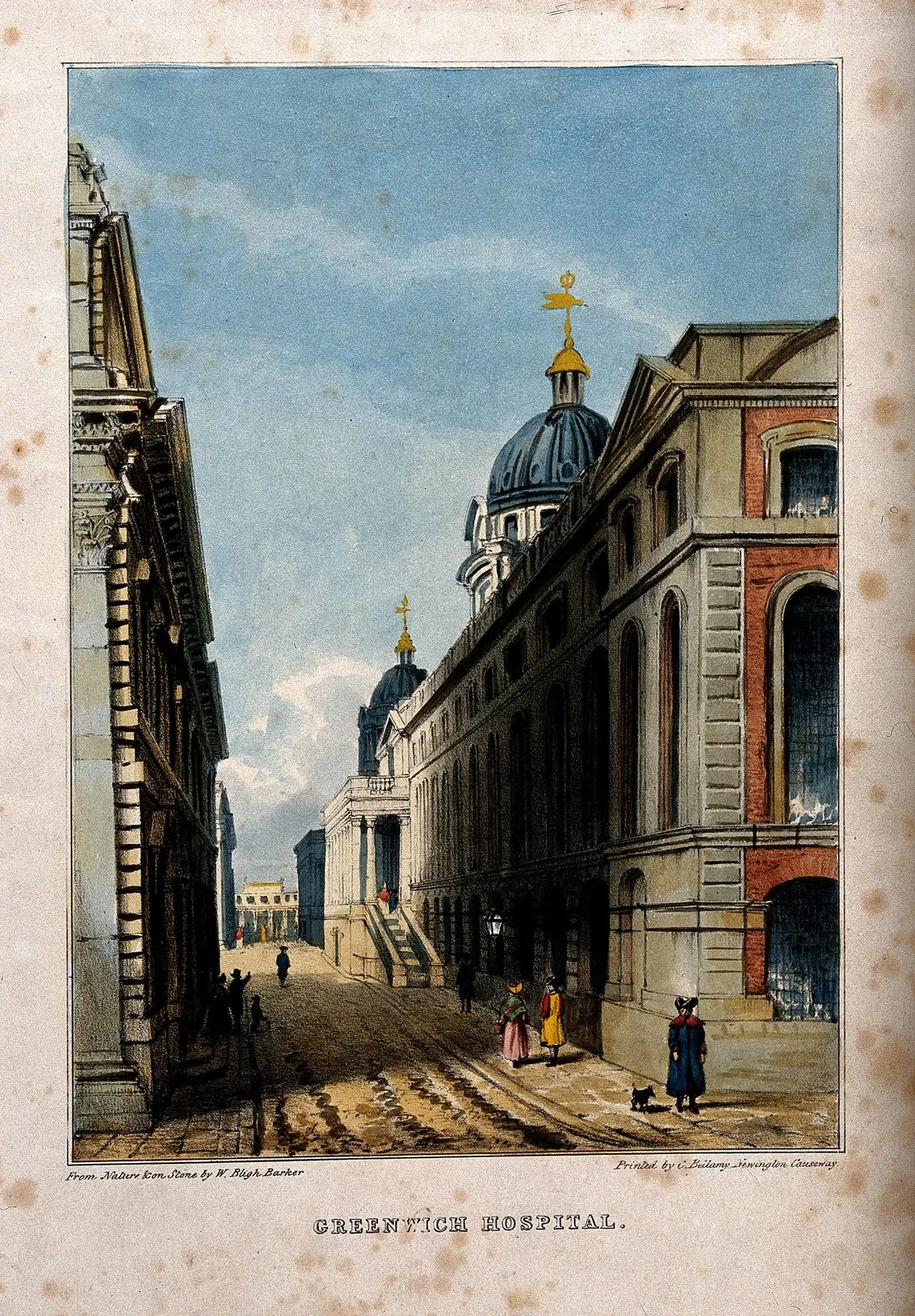
Greenwich street names read like a roll call of Britain’s seafaring past. Take a stroll through the centre of town and you could be forgiven for thinking you had wandered into a naval museum: Nelson Road, Trafalgar Road, King William Walk. That is no accident. Behind almost every one of these names lies a remarkable story of admirals, battles and a riverside town shaped by three centuries of naval power.
Greenwich’s bond with the sea runs far deeper than its street signs. In 1694, William III and Mary II founded the Royal Hospital for Seamen on the Thames, a refuge for sailors broken by war and old age. Building work began before the century was out on the great riverside complex now known as the Old Royal Naval College, and the institution grew into a community in its own right — at its peak in 1814 it was home to 2,710 pensioners.
Around it gathered a school for seamen’s children, founded in the early 18th century, and the Royal Naval Asylum at the Queen’s House; the two later merged, with the school remaining in Greenwich until 1933. When the hospital itself closed in 1869, the Royal Naval College moved into the buildings in 1873 and stayed until 1998. For the best part of three hundred years, the heart of Greenwich belonged to the Navy — a legacy you can still see today in the Maritime Greenwich World Heritage Site, the National Maritime Museum and the Cutty Sark.
The Navy’s influence was never confined behind the hospital gates. Greenwich Hospital was one of the area’s great landowners, and in the early nineteenth century it set about rebuilding the town itself. It acquired large stretches of land to the west — partly, records suggest, as a commercial investment to help fund the care of veteran seamen — and the district around today’s Greenwich Market was comprehensively replanned during the 1820s and 1830s. The hospital’s surveyor, Joseph Kay, designed a formal new town centre on a planned grid, built between 1829 and 1831. It is his street plan, more than anything else, that explains why the modern map of Greenwich reads like a naval history book.
The clearest example is Nelson Road, constructed in 1829 as part of Kay’s new town centre. Its name honours Admiral Horatio Nelson, whose ties to Greenwich went well beyond a street sign. After he was killed at the Battle of Trafalgar in 1805, his body was brought back to Britain, and in January 1806 he lay in state in the hospital’s Painted Hall before his funeral procession continued to St Paul’s Cathedral — an occasion still counted among the great moments in the site’s history. Nelson Road runs alongside the very buildings where the nation mourned its most famous admiral.
A short distance east, Trafalgar Road carries the theme onwards. Laid out in 1825, it drove a straighter route eastwards, bypassing the winding Old Woolwich Road, and new houses and shops soon lined its length as East Greenwich grew. The name recalls the famous 1805 victory off the Spanish coast at which Nelson lost his life — and Trafalgar echoes elsewhere in historic Greenwich too, from the Trafalgar Quarters to the Trafalgar Tavern on Park Row, both noted for their nautical associations.
Then there is King William Walk, once plain King Street, which was extended north from Romney Road towards the Thames during the great nineteenth-century remodelling. Today it forms the western edge of the Old Royal Naval College site, running between Greenwich Park and the river. The name salutes the royal couple who set the whole story in motion: William III and Mary II, whose charter of 1694 created Greenwich Hospital.
Not every old-sounding Greenwich name belongs to the fleet, of course. Crooms Hill predates the naval grid, while the likes of Pelton and Caradoc recall local landowners and industry rather than admirals. The street map is a patchwork, with each era leaving its own layer upon the last.
Taken together, though, the maritime names show just how completely the Navy once ran this town: it owned the land, rebuilt the streets and filled them with pensioners, schoolchildren and officers for three centuries. That heritage still pulls in the crowds — from the museums and the college to gig-goers heading for The O2 on the Greenwich Peninsula. Schools remain central to community life here too — James Wolfe Primary recently tightened security after a pupil slipped away from its breakfast club. And as the borough looks ahead, with a landmark plan for 3,000 new homes at Charlton Riverside, the old street signs endure as Greenwich’s most everyday memorial to its seafaring past.