


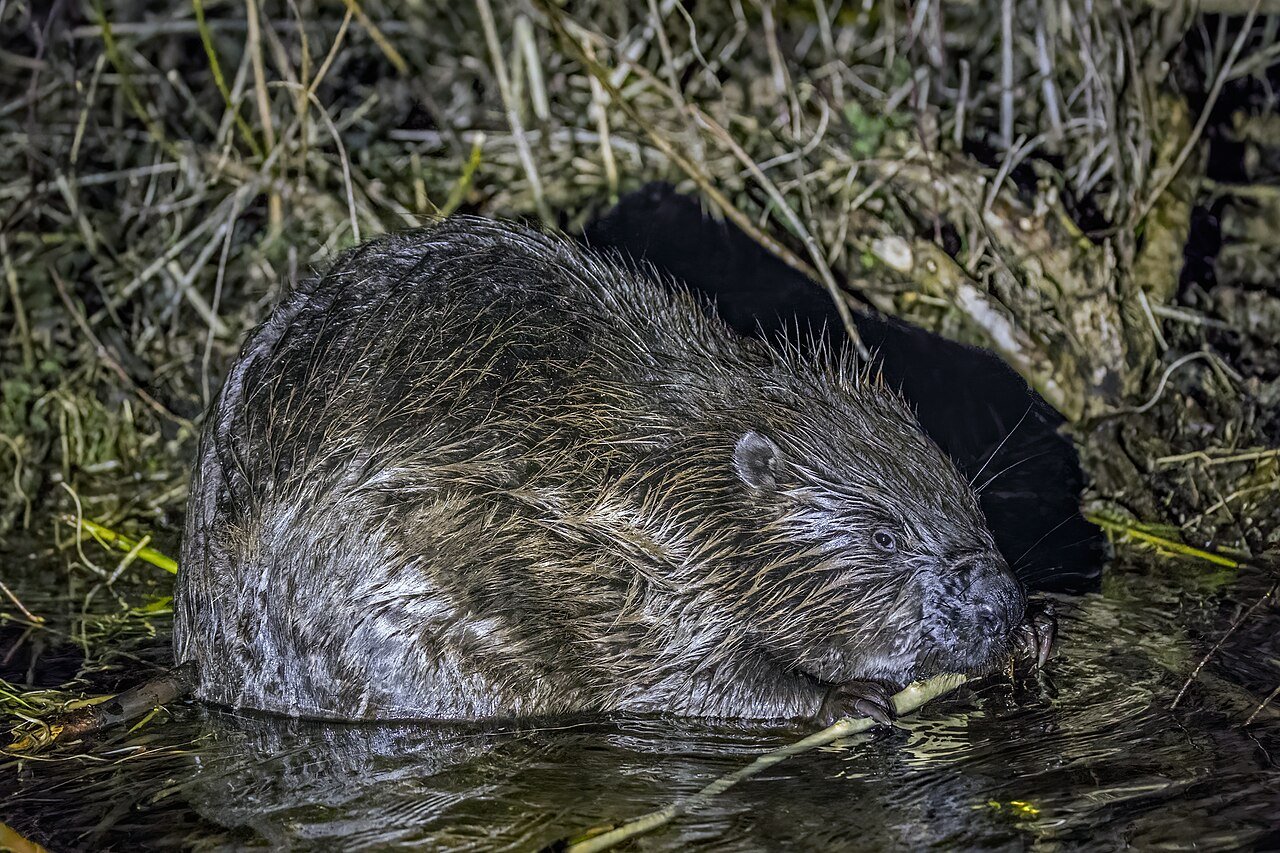
Four years after beavers returned to London for the first time in more than four centuries, the pioneering family at Archers Wood near Forty Hall is going from strength to strength. Recent monitoring has confirmed the family now numbers at least eleven, with new kits spotted swimming alongside their parents.
The milestone was celebrated in fitting fashion as the 4th Enfield Beaver Scouts paid a special visit to the enclosure — a chance for the young scouts to come face to face with the real-life animals behind their group’s name.

Accompanied by experts from Enfield Council and Capel Manor College, the group learned how the animals are quietly transforming the landscape as natural ecosystem engineers, felling trees, building dams and creating wetlands that lift biodiversity across the site.
The visit carried a double significance: it also marked the 40th anniversary of the Beaver Scouts movement in the UK. Cllr Andrew Thorp, Enfield Council’s cabinet member for communications and customer services, said: “Few people get the chance to meet the animals they share their name with, so it was wonderful to welcome 4th Enfield Beavers to our beaver enclosure and celebrate two very special milestones together.”
The group arrived at dusk and gathered at a recently constructed viewing platform, hoping to catch a glimpse of the famously elusive creatures. While the beavers themselves stayed hidden, the young visitors were shown footage captured by monitoring cameras of the animals felling trees, building dams and foraging for food within their expanding habitat.
Cllr Thorp said the beavers’ progress showed what was possible when nature was given room to recover: “The growth of our beaver family is a remarkable success story for Enfield and demonstrates how nature-based solutions can help tackle some of the biggest environmental challenges we face. From reducing flood risk to boosting biodiversity, these animals are already making a significant difference to our local environment.”
“Beaver Scouts give young people a place to belong, and I’m super proud that our animal beaver family have their place to belong, here in Enfield.”
Why Enfield bet on beavers
The beavers, reintroduced in 2022, were the first to return to the capital in over 400 years after the species was hunted to extinction in Britain. Enfield Council’s decision to bring them back was a deliberate experiment in working with nature rather than against it.
Beaver dams slow the flow of water through a landscape, holding it back upstream and softening flood peaks downstream — a natural line of defence for a city increasingly exposed to intense rainfall and surface-water flooding. The ponds and wetlands they create also become havens for amphibians, invertebrates, birds and plant life, weaving richer habitat into the countryside on London’s edge.
The project forms part of the wider Enfield Chase Landscape Restoration programme, an ambitious effort to transform 1,500 hectares of farmland and green space to support nature recovery and climate resilience.
Victoria Beckwith, head of Forty Hall Farm at Capel Manor College, said: “We at Capel Manor are incredibly excited to see beaver numbers growing year on year at Forty Hall Farm and the positive impact they are having on the local landscape, from natural water management and habitat creation to supporting greater biodiversity.”
“Working with Enfield Council and our wider partners, this project brings together conservation, education and community engagement.”
Elsewhere in the capital, nature is finding other footholds too: a rare-breed sheep flock has returned to graze Hampstead Heath’s historic meadows, while a Tiny Forest at Hammersmith Grove recently took top honours at the TfL In Bloom awards.
Beavers bouncing back across Britain
Enfield’s success mirrors a wider beaver comeback. After centuries of absence, the animals have been returning to Britain through a series of reintroduction projects over the past two decades — from the landmark River Otter trial in Devon to enclosed schemes in Kent, Somerset and the Forest of Dean, alongside well-established wild populations in Scotland.
Wherever they settle, beavers have proved themselves master ecosystem engineers. Their dams filter silt from the water, store it through dry spells and create rich wetland mosaics that support a far greater variety of life than the streams they replace. Once persecuted to extinction, the species now enjoys legal protection, and licensed releases into the wild have been given the green light in England — a remarkable turnaround in the beaver’s fortunes.
Back at Archers Wood, every sign points the same way: new kits, an expanding habitat and a family growing year on year. London-wide, the ambition is growing too — TfL has unveiled an updated environment plan with more than 70 actions on carbon, air quality and nature.
As for the young scouts, they headed home at dusk without a live sighting — but with camera-trap footage of dams, felled trees and busy foraging to remember the evening by. The real beavers of Enfield, meanwhile, simply carried on with their night shift: building, gnawing and quietly rewilding a corner of north London.