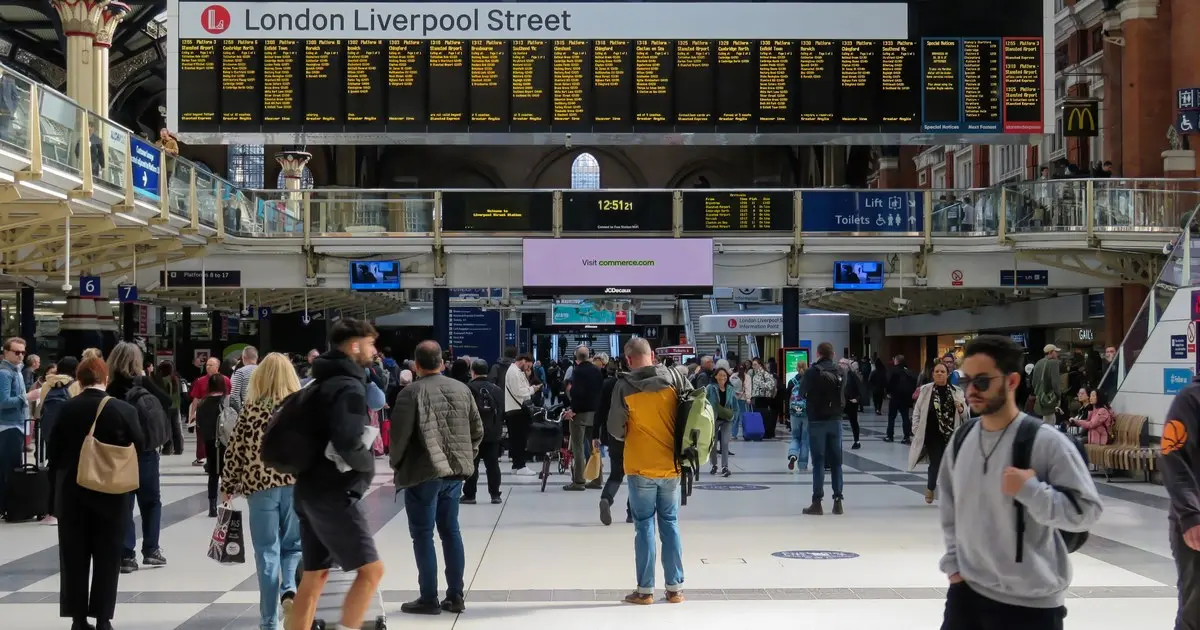
Liverpool Street has become the first station in Britain to record more than 100 million entries and exits in a single year, cementing its place as the country’s busiest station.
The station recorded 102.7 million entries and exits in the year to March 2026, according to new figures from the Office of Rail and Road (ORR).
No station in Britain had ever passed the 100 million mark before. Liverpool Street first claimed the top spot in the year to the end of March 2023, overtaking Waterloo, and has held the title ever since.
A milestone for the railway
Graham Richards, director of planning and performance at the ORR, said: “Liverpool Street becoming the first station to exceed 100 million entries and exits in a single year is a significant milestone for Britain’s railway.”
He added: “Our latest station usage estimates also show increases at major stations outside London, including Birmingham New Street, Glasgow Queen Street and Cardiff Central.”
“This follows our recent passenger rail usage statistics, which showed a 6% increase in journeys across Great Britain in the year April 2025 to March 2026.”
“Our rail usage statistics provide a valuable picture of passenger travel across the country, helping the rail industry understand changing demand and make informed decisions about services and future investment.”
The Elizabeth line effect
The opening of the Elizabeth line in 2022 has contributed to a sharp rise in passengers using Liverpool Street.
Before the line opened, the station was already one of London’s busiest, serving Greater Anglia services to East Anglia, Stansted Express trains to the airport, and London Overground routes. The Elizabeth line added direct services west across the capital to Paddington, Heathrow and Reading, turning Liverpool Street into a cross-London interchange and pulling in millions of extra journeys.
The effect can be seen across the top 10. Five of the country’s 10 busiest stations are now served by the Elizabeth line, including London Paddington, Tottenham Court Road, Farringdon and Bond Street, as well as Liverpool Street itself.
London Paddington was ranked the second busiest station in the country, with 72.9 million entries and exits, while Waterloo took third place with 71.6 million.
Waterloo’s long reign ends
Waterloo had been Britain’s busiest station for years, a position built on its vast commuter flows from south-west London, Surrey and Hampshire. Liverpool Street’s rise past it in 2023 marked a shift in the capital’s travel patterns, as east London’s growth and the Elizabeth line redrew the map of the busiest stations.
The gap has widened since. Liverpool Street now handles around 30 million more entries and exits a year than Waterloo, a difference roughly equal to the entire annual usage of a major regional station.
The figures count entries and exits, meaning each passenger is counted twice on a return journey — once on arrival and once on departure. Even so, the scale is striking: 102.7 million entries and exits works out at more than 280,000 a day, every day of the year.
What it means for passengers
Record numbers bring their own pressures. The station’s concourse is at its busiest in the morning and evening peaks, and the lift serving the station is closed until February 2027, leaving step-free passengers to use alternative routes.
Across the capital, demand keeps rising. St Pancras is set to double its capacity by 2029 to cope with growing numbers, and the ORR’s figures suggest the pressure on London’s stations is not easing.
For Liverpool Street, the record is a sign of how far the station has come — and of how much of London’s growth now runs through the east of the city.