


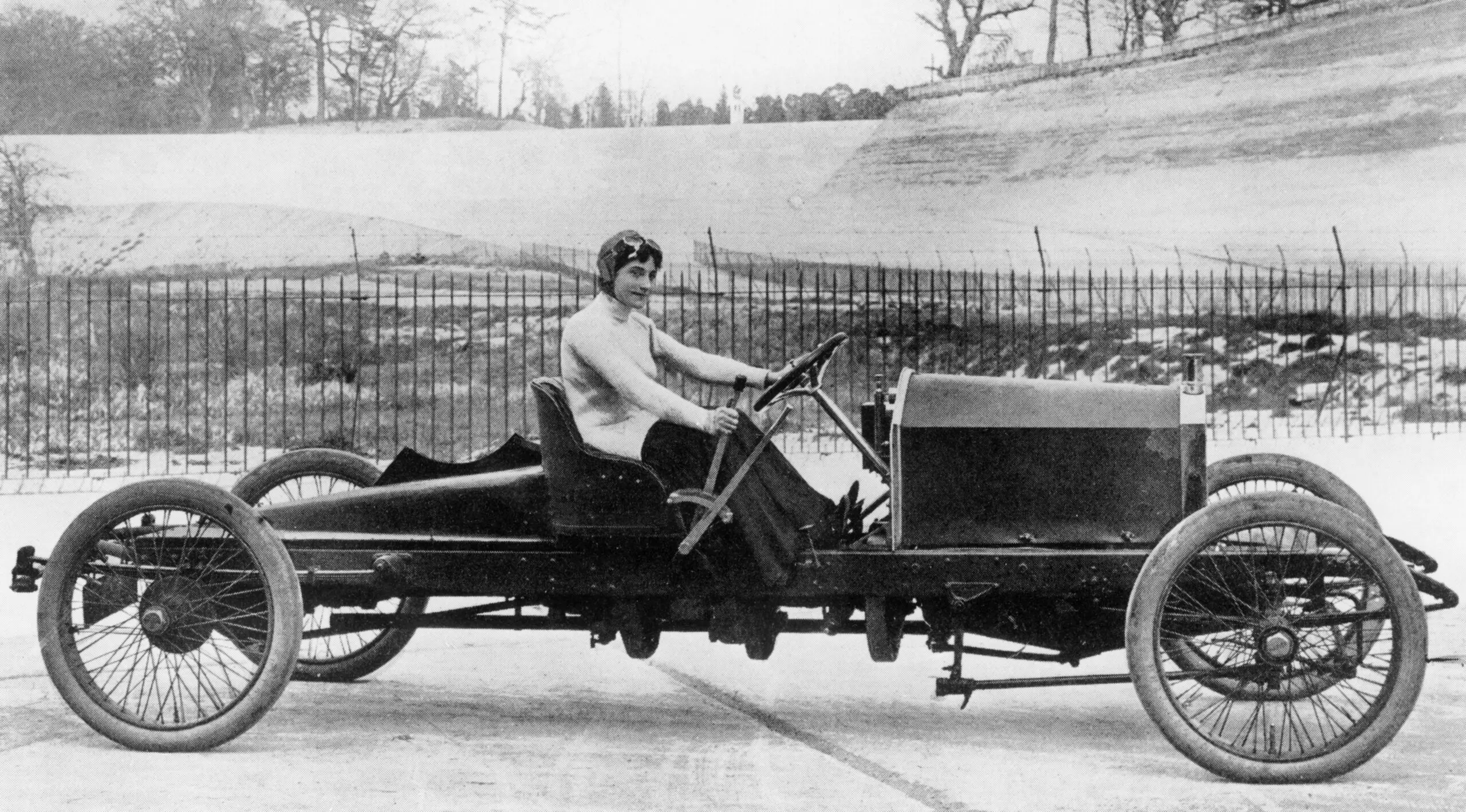
A pioneering racing driver once hailed by newspapers as the “fastest girl on Earth” has been given a permanent place on the streets of the borough where she was born, after a blue plaque honouring Dorothy Levitt was unveiled at her former home in Hackney.
The plaque celebrates a woman who smashed through the boundaries of Edwardian Britain: the country’s first female professional racing driver, and the first woman anywhere to hold world speed records on both land and water.
The tribute was donated by American philanthropist Jerry Klinger, who leads the Jewish American Society for Historic Preservation, and was organised by Martin Sugarman, the Hackney-born Jewish community historian and archivist of the Association of Jewish Ex-Servicemen and Women (AJEX).
Who was Dorothy Levitt?
Levitt, a Jewish Londoner born Elizabeth Levi in Hackney on 5 January 1882, packed extraordinary achievements into a life of just 40 years.
She taught Queen Alexandra and the royal princesses to drive at a time when the motor car itself was still a novelty. In 1905 she set the record for the longest drive by a woman motorist, taking a De Dion-Bouton from London to Liverpool and back over two days — a feat of endurance on the rough, unlit roads of the era.
On the track and the water she was unbeatable. In 1903 she won the inaugural British International Harmsworth Trophy for motor boats and set the world’s first water speed record. Two years later she clocked 79.75mph at the first Brighton Speed Trials, and in 1906 she pushed her own ladies’ world land speed record to 90.88mph at Blackpool in a 100hp Napier. The astonished press dubbed her the “fastest girl on Earth” and the “champion lady motorist of the world”.
Levitt was as influential off the circuit as on it. A motoring journalist and columnist for The Graphic, she published The Woman and the Car in 1909 — a pioneering handbook that championed a woman’s “right to motor” and offered practical advice to women drivers decades before motoring became mainstream. She died on 17 May 1922, aged 40, but her legacy as a pioneer of both female independence and motoring endures.
How blue plaques are awarded — and how to see this one
The new plaque is a community-led tribute rather than part of English Heritage’s official London blue plaques scheme. Under the official scheme — which dates back to 1866 and has been run by English Heritage since 1986 — honourees must have died at least 20 years ago, have made an exceptional contribution to human welfare or happiness, and be commemorated on a building that survives in a form they would recognise. Members of the public can nominate figures for consideration.
Alongside that national scheme, councils, heritage societies and individuals regularly put up their own plaques to celebrate local heroes — as has happened here, with the plaque funded by Klinger’s society and driven by Sugarman’s research into Hackney’s Jewish history.
For anyone wanting to see it, the plaque is mounted on the outside of Levitt’s former Hackney home and can be viewed free of charge from the street — a new stop for plaque-spotters and anyone tracing the capital’s motoring heritage. Those keen to explore more of London’s past can also head to the British Museum, which recently added an audio tour of the Bayeux Tapestry after a blind visitor’s plea, while heritage transport fans can climb aboard the Kent heritage railway’s autumn programme of steam events.
The tribute adds another chapter to Hackney’s rich community story — a borough whose calendar of local events keeps evolving, with Dalston’s beloved pumpkin lantern festival scrapped for 2026, but whose appetite for celebrating its own remains undimmed. Levitt, the Hackney-born daughter who conquered speed on land and sea, is now remembered where her remarkable story began.