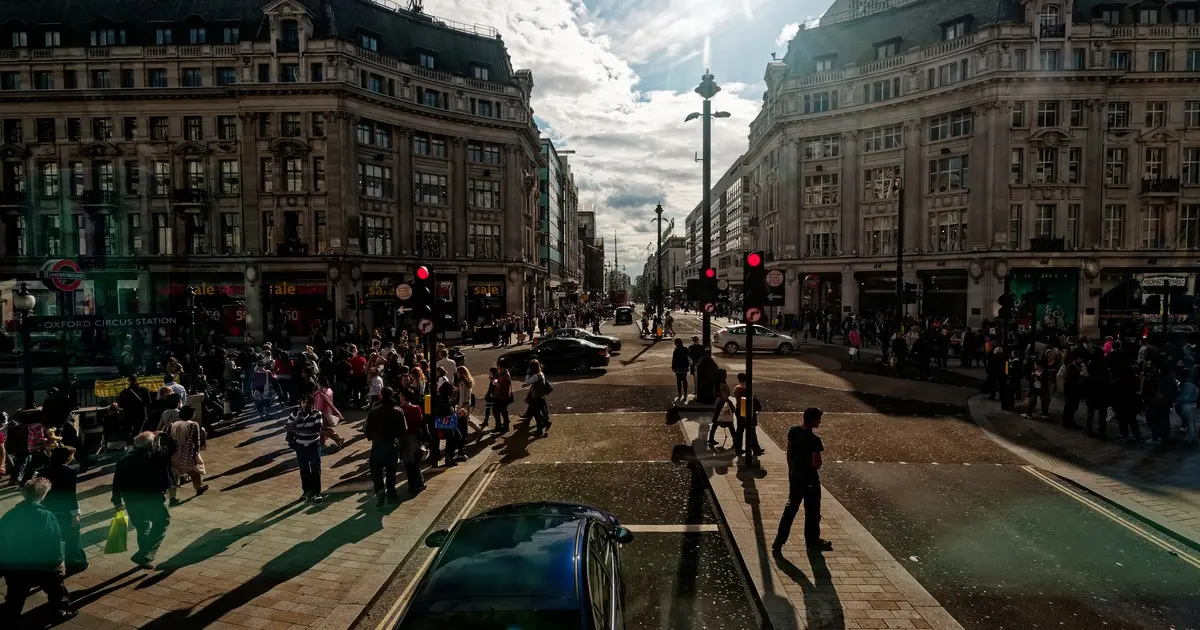
Shoppers stepping onto Oxford Street today found a street transformed. Almost a kilometre of the capital’s most famous shopping thoroughfare, between Orchard Street and Great Portland Street, is now completely free of traffic, as a long-debated pedestrianisation scheme finally came into force.
Vehicles that once clogged the stretch have been rerouted onto nearby roads, leaving the pavement and carriageway to pedestrians for the first time. The change lands just as the Christmas shopping season approaches, and covers a part of London where annual spending runs to around £3.1 billion.
London Mayor Lord Sadiq Khan, who has championed the scheme, described the moment as a turning point for the street. “I’m hugely excited to see my bold vision for Oxford Street coming to life from today,” he said. “For centuries, Oxford Street has reinvented itself, adapting to changing times and helping shape British culture along the way.”
He added: “There has been talk of pedestrianising Oxford Street for decades. After so many false dawns, and now working with a Government who share the scale of my ambition, I’m proud that we’re finally unlocking a new era for the street.” He called the day “a truly momentous occasion for the capital.”
What is banned, and what still runs
The new rules are sweeping. Buses, taxis, private hire vehicles, private motorised vehicles, cycles, scooters and pedicabs are all prohibited within the traffic-free zone. Deliveries are restricted to the overnight window between midnight and 7am, while emergency services keep access at all times.
The idea, City Hall says, is to put Oxford Street alongside the world’s great shopping destinations, with Times Square in New York and the Champs-Élysées in Paris named as the benchmarks. The pedestrianisation forms part of a broader regeneration project for the area, rather than a standalone traffic measure.
Not everyone is convinced. Concerns have been raised that traffic pushed off Oxford Street could simply pile up on surrounding roads, adding to congestion in the streets around the zone. Westminster City Council’s deputy leader, Councillor Tim Barnes, has voiced concerns about the speed of the preparations, and the switch has drawn criticism from those who fear the surrounding area will bear the brunt.
Where buses go now
Bus passengers will need to adjust. New stops have been set up along Wigmore Street, Henrietta Place and Cavendish Place, roughly 200 metres from the traffic-free zone, for routes diverted around it. Anyone heading to the street itself should allow for the short walk from those stops.
The timing is deliberate. With the festive season approaching, the hope is that a calmer, safer street will draw shoppers back in numbers at the busiest time of the retail year. Whether the scheme delivers on that promise — and whether the surrounding streets cope with the diverted traffic — will become clear over the coming weeks.
For now, the stretch between Orchard Street and Great Portland Street belongs to people on foot. It is the end of decades of argument about what Oxford Street should be, and the start of a test of whether a pedestrian-first version of it can thrive.
The mayor’s own account underlines how long the idea has been in the air. Talk of pedestrianising the street has gone on for decades, he said, and the scheme only moved forward once City Hall found a Government willing to match the scale of its ambition. That history is why today’s change is being presented not as a trial or a temporary closure, but as the beginning of a new era for one of the capital’s best-known streets — one that will now be judged on whether shoppers, businesses and the surrounding roads all benefit.
Londoners facing other disruption this week should also note the overnight M25 closures running across four nights, while Elizabeth line passengers face a ten-day Christmas closure later in the year.
Library photo: Oxford Circus and Oxford Street. Credit: Txllxt TxllxT, CC BY-SA 4.0.