


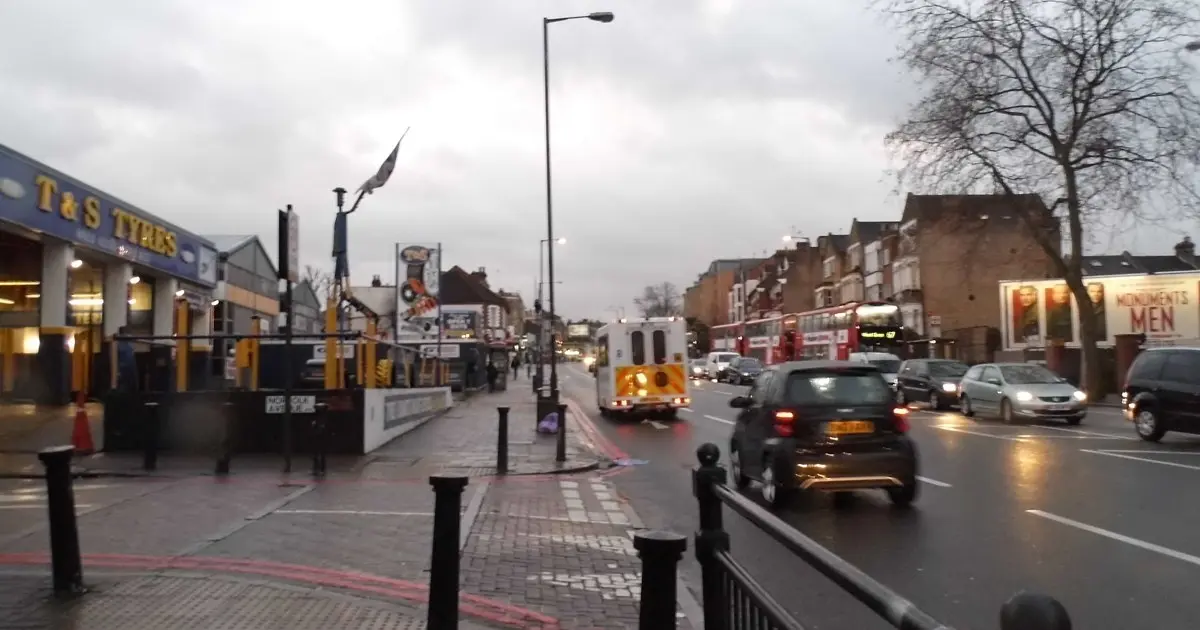
A man has been rushed to a major trauma centre after a crash on Tottenham High Road shut the road in both directions and forced the closure of South Tottenham station yesterday evening.
Emergency crews were called to High Road in Tottenham at 4.32pm on Tuesday after reports of a road traffic collision. Ambulance crews and paramedics in fast response cars reached the scene shortly afterwards — the solo-response vehicles that can often thread through rush-hour traffic faster than a full ambulance to begin treatment at the roadside.
A London Ambulance Service spokesman said: “We were called at 4.32pm yesterday to reports of a road traffic collision in High Road, Tottenham. We sent an ambulance crew and paramedics in fast response cars to the scene. We treated a patient at the scene and took him to a major trauma centre as a priority.”
No further details about the patient’s condition have been released. The ambulance service described only a single patient being treated at the scene and taken on to hospital; no other casualties were mentioned.
Road and station closures
High Road was closed in both directions between Ferndale Road and Seven Sisters Road following the collision, triggering heavy traffic through Tottenham and neighbouring Stamford Hill as the evening rush hour got under way.
The closure cut through one of north London’s busiest corridors. High Road is the spine of Tottenham, carrying heavy bus and car traffic between Seven Sisters and Tottenham Hale — so shutting it in both directions during the peak had an immediate ripple effect. Traffic was reported queuing through surrounding streets as drivers tried to loop around the cordon.
South Tottenham station was also closed as a result of the incident, and a string of bus routes were diverted or delayed around the closure — routes 76, 243, 279, 149, 318 and 476 were all affected, leaving commuters hunting for alternatives during one of the busiest periods of the day.
The disruption dragged on through the evening, with road closures and public transport knock-on effects felt across the area long after the road was shut. The cause of the collision has not been disclosed.
Major trauma centre care
Being taken to a major trauma centre “as a priority” means the patient’s injuries were assessed as serious enough to bypass the nearest A&E in favour of specialist care. London has four major trauma centres — at St George’s in Tooting, St Mary’s in Paddington, the Royal London in Whitechapel and King’s College Hospital in Denmark Hill — equipped to handle the most severe injuries around the clock.
Paramedics make that call at the scene: where time is critical and injuries complex, crews will travel further to reach a centre with trauma surgeons, specialist imaging and intensive care on immediate standby. On arrival, patients are met by a full trauma team rather than joining a normal A&E queue.
Getting around the area
Anyone travelling through north-east London this morning is advised to check TfL’s status updates before setting off, as residual disruption can linger into the day after evening closures. Check the latest Tube and rail disruption here, and allow extra time on buses diverted around High Road.
Travellers who would normally use South Tottenham station — served by the London Overground — can instead head for Seven Sisters on the Victoria line a short distance to the south, or use the diverted bus routes where they resume normal service.
The collision is the latest to close a busy London arterial road this week — a crash in Hayes also shut Judge Heath Lane with diversions in place.