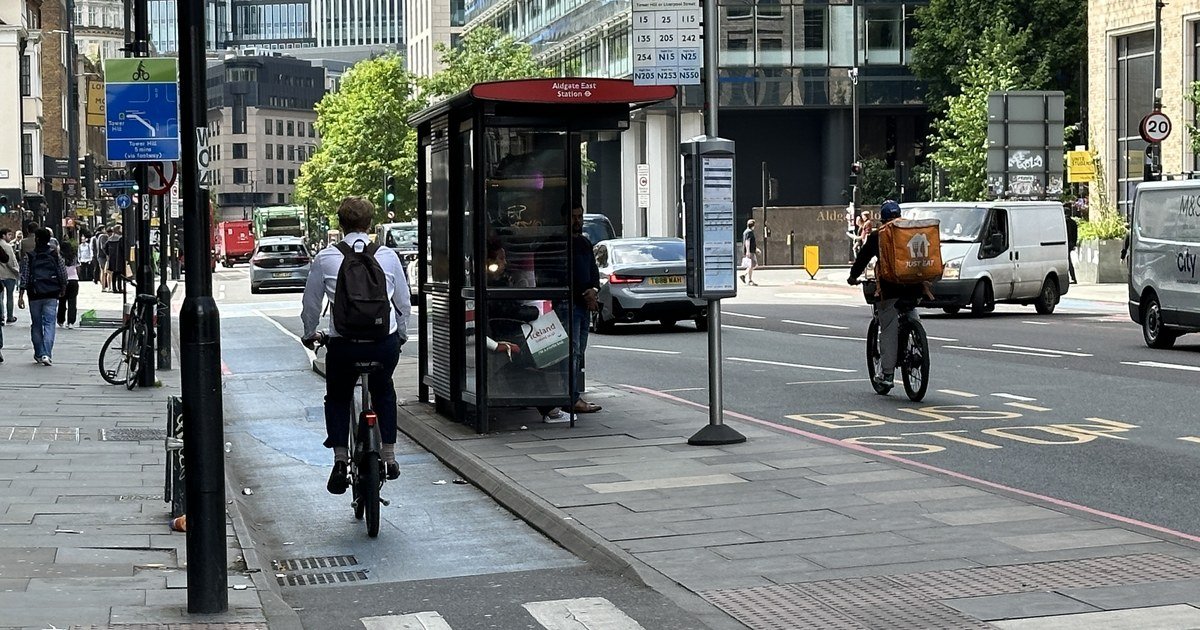
Transport for London has insisted that floating bus stops present a “very low” risk to pedestrians, after publishing three new safety reports today.
The reports, released on Friday 13 November, confirm TfL’s position that it is “rare” for a pedestrian and a cyclist to collide at a floating bus stop, also known as a bus stop bypass.
A floating bus stop is where a cycle track and a bus stop interact, with passengers often needing to cross over a cycle lane to get on or off the bus. For TfL, they play a major role in building more protected cycleways across London while keeping the current road space for motorists.
But campaigners, including the National Federation of the Blind, have consistently raised concerns about the accessibility and safety of the stops for older and disabled people.
TfL says there were only five pedestrian casualties involving cyclists and one involving an e-scooter over the three-year period analysed, compared with 11,400 pedestrians injured in collisions with motorists over the same period.
The new reports update a safety review TfL published in 2024, after incorrect data was found around the implementation dates of some bus stop bypasses. Last year ministers announced a pause on the rollout of one type of floating bus stop, known as a Shared Use Bus Border, where the cycle lane runs across the front of the stop. That pause did not prevent future construction of bus stop bypasses, where the bike lane runs behind the stop. Together, both types make up around 1.5 per cent of the capital’s 19,000 bus stops.
Sarah Gayton, from the National Federation of the Blind, claimed the true figure is far higher because of unreported injuries at floating bus stops. “There is an accessibility crisis in London,” she said. “It’s dangerous, discriminatory and disgusting. The Mayor wants to get people cycling without thinking of the impact on people in this city. There are lots of incidents, but nobody is reporting them.”
She also suggested that disabled Londoners — especially those with mobility or sight issues — are staying away from the stops altogether. The TfL report appears to confirm this, noting that when comparing boarding levels at bus stops before and after bypasses were built between 2019 and 2022, there was a slightly greater reduction in the number of older and disabled passengers at bus stops where bypasses were built, by up to three per cent. TfL said this was not “statistically significant”.
“The data does not include the people who are too scared to go near them,” Ms Gayton said. “Does every journey really matter? TfL do not know what they are doing — they need to listen to the London Assembly and pause them.”
Last week the London Assembly passed a motion calling for a pause in the installation of floating bus stops, suggesting the designs have left some people “fearing for their safety”. The motion, which is non-binding, cited a series of incidents at floating bus stops across the capital, including a disabled man who was hit in the ribs and ankle by an e-bike after getting off a bus in Camden.
Reform UK Assembly Member Keith Prince, who proposed the motion, said: “I’m disappointed that Transport for London’s report supports the continued use of floating bus stops and dismisses safety concerns. It is a missed opportunity to put Londoners’ safety first and address the serious concerns raised by blind, partially sighted, older and disabled Londoners. My motion in City Hall last week was a step in the right direction that saw all political parties working together. I will keep working to eliminate floating bus stops from London.”
Green Party Assembly Member Caroline Russell acknowledged that the concerns of older and disabled Londoners needed to be “heard and acted on”, but urged TfL to continue rolling out the “important” bus stop type. “The evidence shows that bus stop bypasses have reduced the number of people killed or seriously injured on our roads,” she said. “They are an important part of making cycling a safe option for getting around London, allowing people to ride their bikes behind stationary buses rather than having to weave into dangerous traffic. This TfL review is about improving the design of existing bypasses rather than questioning whether this very sensible measure should exist and I welcome that.”
It came just a week after London TravelWatch, the capital’s transport watchdog, also called for a pause on any new bus stop bypasses.
Will Norman, London’s Walking and Cycling Commissioner, said: “The Mayor and I remain committed to enabling safe and sustainable travel across the capital for everyone. It’s encouraging to see data confirming that the risk of bus stop bypasses to pedestrians is extremely low, but also that TfL remains committed to making this infrastructure work for everyone. We will continue working with Londoners and organisations to understand their experiences and explore potential transport network enhancements as we build a greener, safer, better London for all.”
The debate over floating bus stops is the latest in a series of transport rows in the capital. Richmond Council this week refused bus-priority measures for the SL7 and 285 routes, and the Elizabeth line will close for a weekend at the end of the month.