


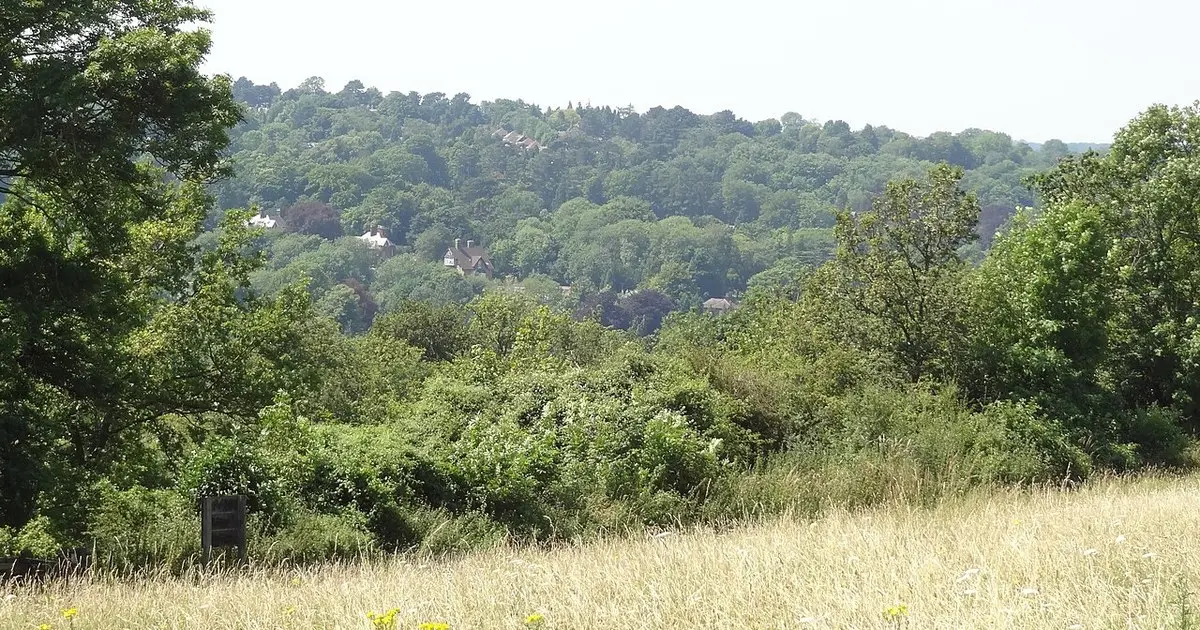
The Croydon common with a Roman road, sunset views and 2,000 years of history
Between Kenley and Riddlesdown lies one of Croydon’s lesser-known green spaces — and there is much more hiding among its woodland and chalk grassland than the views alone.
Riddlesdown Common opens out into sweeping countryside and impressive sunset views, despite being surrounded by south London. Its history stretches back thousands of years, from a route believed to have Roman origins to a Victorian pleasure resort and the fight to preserve the common for the public.
A road the Romans may have built
Riddlesdown has been crossed for centuries, with one old route through the common believed to have Roman origins. Thousands of years of human activity have left their mark on Riddlesdown, with earthworks and old trackways surviving across the landscape.
One former road running through the middle of the site is believed to be of Roman origin and once ran from London towards the coast. It was probably used as a transport link between networks of Roman iron works across south-east England and remarkably remained open to vehicles well into the 1970s.
Possible traces of Iron Age fields have also been identified, while a deep ditch along the north-western boundary is protected as a Scheduled Ancient Monument. The archaeological significance of the landscape has led Croydon Council to designate the whole of Riddlesdown as an Archaeological Priority Zone.
From pasture to public common
For much of its later history, Riddlesdown was used as pasture, with livestock grazing across what would once have been a much more open landscape. The arrival of the nearby railway in the 1850s brought change, with the common later facing the threat of enclosure.
Following efforts by a local family to preserve the land, the City of London Corporation bought most of Riddlesdown in 1883 for public benefit. But that same year brought tragedy. Two chalk pits beside Godstone Road were considered so dangerous that fencing was planned to protect visitors. Before it could be installed, a child died after falling into one of the pits. Two labourers were then employed to warn people away until wooden fencing was installed in October 1883.
Less than a decade later, part of Riddlesdown took on a rather different identity. In 1892, brass founder and fairground manager William Gardner opened a tea garden on its lower slopes as part of Gardner’s Pleasure Resort.
A haven for wildlife
Today, the common is perhaps better known for its landscape and wildlife. Riddlesdown forms part of the South London Downs National Nature Reserve, a 417-hectare area along the border between Croydon and Surrey. Declared in 2019, the reserve includes Riddlesdown, Farthing Downs, New Hill and Happy Valley, alongside other sites including Coulsdon Common and Kenley Common. At 417 hectares, it is the second-largest National Nature Reserve in London after Richmond Park.
Riddlesdown itself contains chalk grassland, ancient woodland, old hedgerows, former quarries and what the City of London describes as the single most expansive area of chalk scrub in Greater London.
Its chalk grassland is one of Europe’s rarest and most species-rich habitats, with as many as 40 species of flowering plants able to grow within just one square metre. Rare plants recorded there include greater yellow-rattle and early gentian, while butterfly surveys since 1990 have identified 32 species. Skylarks, linnets, kestrels and peregrine falcons can also be found around Riddlesdown, alongside several species of bat, roe deer, foxes, badgers and the rarer hazel dormouse.
Parts of the landscape are still grazed, continuing Riddlesdown’s centuries-old association with livestock, while chalk grassland is cut to prevent scrub from taking over.
Walking through Riddlesdown today, the railway, roads and houses are never particularly far away. But once among the grassland and woodland, parts of the common feel remarkably removed from the rest of Croydon. Traces of its past remain across the landscape, from ancient earthworks and a route believed to have Roman origins to former chalk workings and the site of a Victorian pleasure resort. And beneath one of Croydon’s most distinctive green spaces is a history which has seen ancient travellers, grazing livestock, Victorian day-trippers and generations of walkers cross the same stretch of land.
London’s last 4pm sunset was today — here is when the evenings start getting lighter again, and Jasmine Park in Bow has reopened with new play equipment.