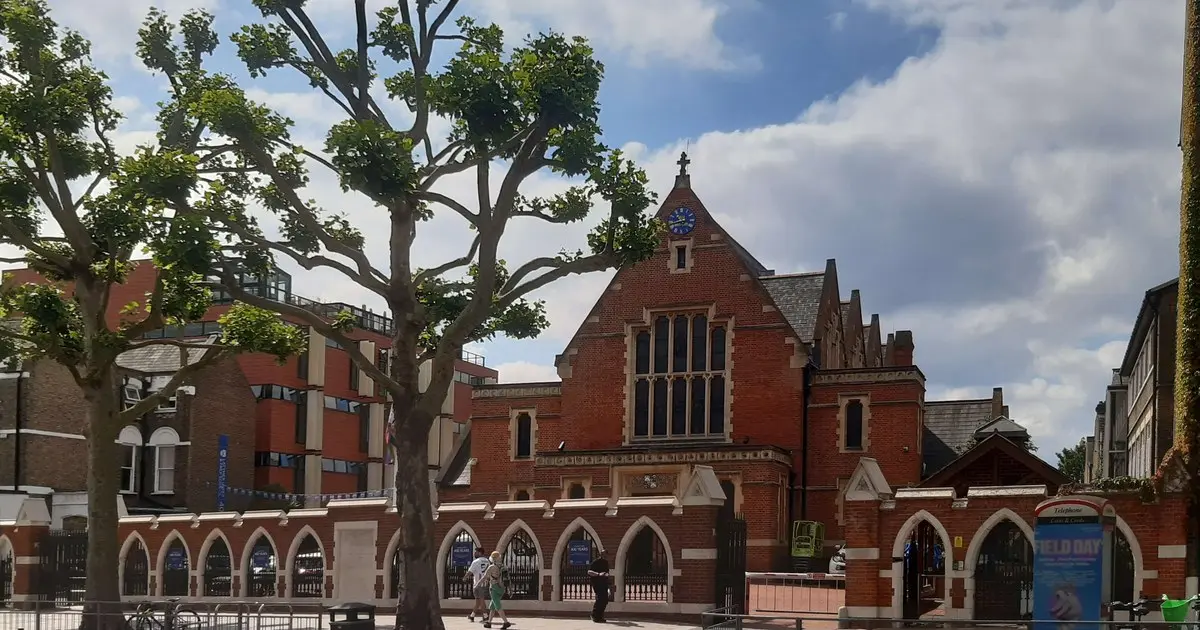
A leading London private school that planned to scrap GCSEs in favour of its own qualifications has abandoned the project — because universities are now using artificial intelligence to filter applications.
Latymer Upper School in Hammersmith said that dropping most GCSEs would have risked its pupils being filtered out by universities’ automated selection processes, many of which have been introduced since the plan was first revealed in 2023.
The school had intended to create an alternative curriculum to GCSEs, keeping only English and maths. Teenagers would have ended up with a portfolio and transcript of what they had learnt in each subject, with a grading system of pass, merit and distinction under consideration.
But senior leaders have now rowed back. Ian Emerson, the school’s senior deputy head, said the decision was taken “reluctantly”, because the school still believes “the GCSE curriculum needs a thorough rethink”.
He said: “The decisive factor was that we weren’t prepared to risk our young people’s future university applications.
“When we began this project, everything we heard from universities was that they supported more in-depth, scholarship-focused qualifications. However, higher education applications have changed dramatically since then.”
Emerson pointed to funding pressures that have led to the decentralisation of admissions offices, and to advances in AI that mean applications are increasingly filtered through algorithmic criteria.
“We came to realise there was no way to avoid our students being automatically evaluated against standard GCSE benchmarks, both in the UK and in Europe,” he said.
The school decided it was not worth the risk of a pupil’s application being rejected by an algorithm before it was ever read by a human.
A wider debate about GCSEs
Latymer Upper is not alone in questioning the GCSE system. The pandemic, when exams were cancelled, prompted calls for reform, and a review by the Independent Assessment Commission recommended an overhaul — including that testing should not be based solely on a fixed age of 16. The commission argued that the current model, largely unchanged for decades, no longer reflects how young people actually learn.
Critics argue the current system relies too heavily on end-of-course exams, offering little room for ongoing assessment. Various education stakeholders have called for reduced assessment burdens, more flexibility, and alignment with 21st-century demands.
Some top private schools are already voting with their feet. St Paul’s Girls’ School offers a core of seven GCSEs supplemented by non-core alternatives, while Bedales does the same with a core of just five GCSE subjects.
Latymer Upper itself achieved outstanding GCSE results this summer, with 93 per cent of pupils achieving at least a grade 7 — equivalent to an A — and 55 per cent obtaining the highest grade of 9.
AI and the future of admissions
The school’s decision highlights how quickly AI is reshaping university admissions. As institutions face rising application volumes and tight budgets, automated filtering has become an attractive way to manage the load.
Admissions offices have been under pressure for years. Application numbers have climbed steadily while funding per student has been squeezed, leaving many universities looking for ways to process thousands of applications efficiently. AI tools promise to do that — but they also risk entrenching the very standardisation that curriculum reformers want to escape.
For schools considering radical curriculum reform, the message is sobering: however innovative the qualification, if it cannot be read by a machine, it may never reach a human.
The debate about the future of GCSEs will continue — but for now, at Latymer Upper, the traditional exams stay.
London Streets has been covering Barnet grammar schools topping the GCSE tables and primary school demand in Barking and Dagenham this week.