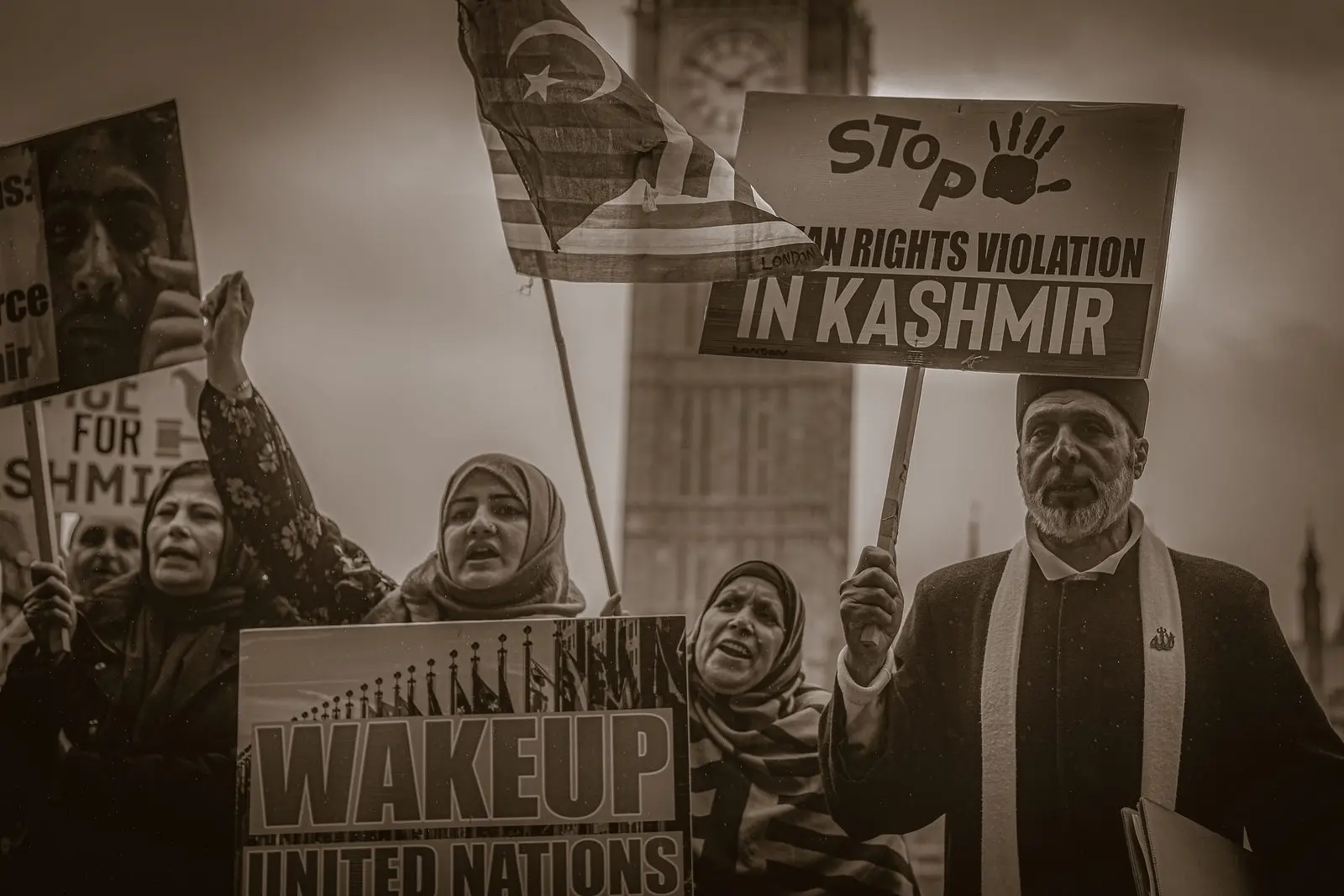
Members of the United Kingdom’s Kashmiri community took part in a protest in central London on Sunday, gathering near Downing Street before marching through the capital to Trafalgar Square. The demonstration was organised by the Jammu Kashmir Joint Awami Action Committee (JKJAAC).
The event, as described by the organisers, was intended to draw attention to claims about the situation in the area they refer to as Pakistan-occupied Jammu and Kashmir (PoJK), an area often described in international reporting as Pakistan-administered Kashmir. This report sets out what the organisers said, what could be established about the policing of the London event from official material, and the wider context. It does not present the organisers’ allegations as independently verified facts.
What the organisers say
JKJAAC said a large number of people had travelled from different parts of the UK to take part, and that those present included women, children, young people and elderly participants. The committee said protesters gathered near 10 Downing Street, where, according to the organisers, participants raised slogans including “Foreign Forces Go Back”, “Pakistani Forces Go Back” and “Stop Killing in Kashmir”.
According to the organisers, women and children were also seen carrying placards and banners. They said the messages called for justice for people the organisers said had been killed during what they described as a public rights movement, an end to what they described as enforced disappearances, the release or recovery of detained people, and protection for fundamental human rights.
In a statement shared by the organisers, as recorded in the original report, protesters said the demonstration was intended to seek justice for affected families. They said they wanted to highlight concerns about reported civilian deaths, arrests and detentions, and restrictions on communications in the region. These are claims made by the organisers. No specific casualty figures were given in that recorded account, and no unverified figure is presented as fact here.
JKJAAC also said the protest was aimed at drawing the attention of the British Government, international human rights organisations and the wider international community to what it described as a deteriorating situation in the region. That is the organisers’ characterisation.
The London policing
The original report did not record a Metropolitan Police position on this demonstration, and it did not give an official turnout figure or official information about arrests. A search of the Metropolitan Police news site for “Kashmiri” returned no results when checked for this update, and no Met statement specific to this protest was found in the material reviewed.
For that reason, this report does not give an official attendance number and does not state whether arrests were made. Social-media estimates of crowd size, where they appear, should be treated as unverified unless confirmed by an official source. Any confirmed update on policing, turnout or arrests would need to come from a published Metropolitan Police statement or a direct police response.
Background
London is home to a British Kashmiri community, and Whitehall, Downing Street and Trafalgar Square are frequently used by diaspora and campaign groups for marches intended to raise awareness with Parliament, government, news organisations and international bodies. Protests in this part of the capital are therefore often symbolic as well as local, designed to be seen beyond the immediate crowd.
In independently documented international context, the United Nations human rights office, OHCHR, published a report on Kashmir in June 2018, which it described as its first on the subject and which covered both Indian-administered and Pakistan-administered Kashmir, with a later update in 2019. That historical UN material is separate from the current allegations described by JKJAAC, and it does not by itself verify those current claims.
As recorded, the march concluded at Trafalgar Square. Beyond the organisers’ account above, the specific allegations remain attributed claims. If the Metropolitan Police, the UK Government or an international body publishes a specific response, that would provide further verified information for an update.