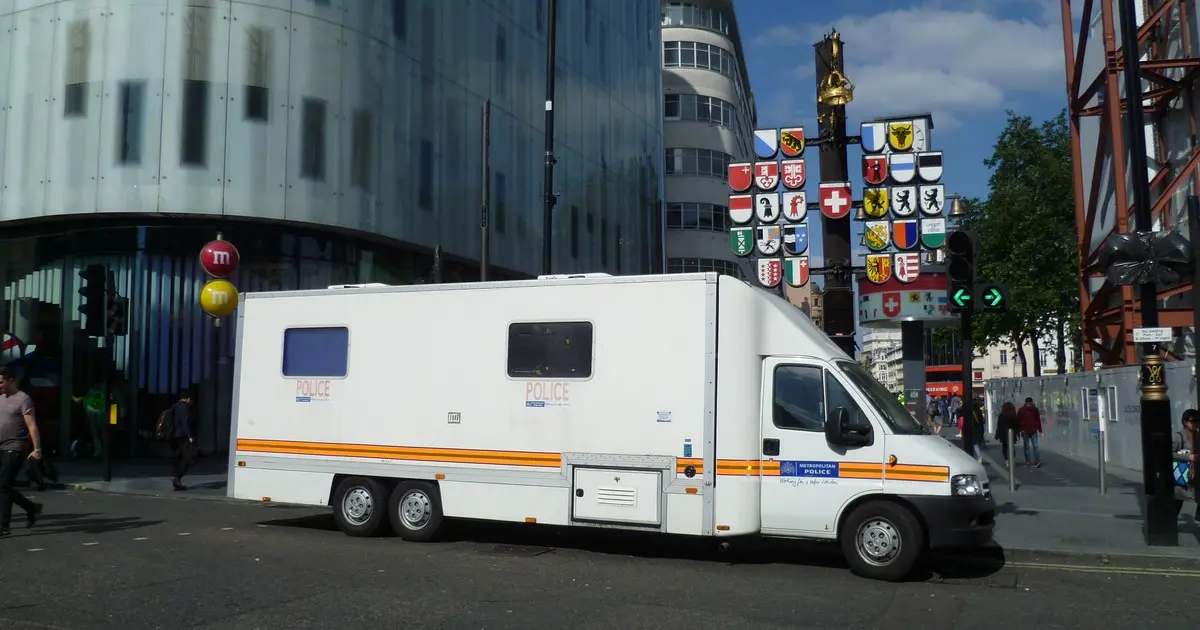
A Metropolitan Police van in Leicester Square (Philafrenzy, CC BY-SA 4.0, via Wikimedia Commons).
The Metropolitan Police recorded 279,664 violence against the person offences across London in the year ending September 2026, new data shows — a 7.6 per cent rise on the previous 12 months.
The figures, drawn from the force’s own crime dashboard, show that while the total remains on the rise year-on-year, September itself brought a small sign of relief: violence offences fell by 3.3 per cent compared with August, suggesting the upward trend may be easing as autumn arrived.
Violence against the person is one of the broadest crime categories the Met records. It covers everything from common assault and harassment to grievous bodily harm, robbery and homicide — which means the headline number hides very different experiences from one borough to the next.
Westminster tops the rate table
Measured per 1,000 residents, Westminster is London’s most violent borough by some distance, with 47 offences per 1,000 people over the year. Barking and Dagenham came second at 39, followed by Tower Hamlets on 37.2, Lewisham on 36.2, Greenwich on 35.8, Camden on 35.0 and Islington on 34.9.
The Westminster figure needs some careful reading, though. The borough has one of the smallest resident populations in the capital, yet on any given day it absorbs commuters, shoppers, revellers and tourists in vast numbers.
Soho’s late-night bars, the West End’s clubs, Trafalgar Square’s protests and the daily churn of the borough’s stations mean enormous numbers of potential victims and offenders pass through a very small population denominator. When a borough with that kind of footfall is measured purely by residents, its rate will always look extreme — the same arithmetic that has long made the Square Mile look off the charts for City of London Police figures.
Barking and Dagenham, in second place, is a different story: a large residential borough where the rate reflects what residents experience day to day, not what visitors bring with them.
On raw numbers, Croydon leads
Measured by volume rather than rate, the picture shifts. Croydon recorded the most violence against the person offences of any borough in the 12 months to September — 12,443 — narrowly ahead of Westminster on 12,242.
Brent followed with 11,280, then Lewisham with 11,235 and Lambeth with 10,819. All five are large, densely populated boroughs, which partly explains their high totals: more people means more opportunity for crime of every kind.
That distinction between rate and volume matters for anyone trying to read the table honestly. A borough can look frightening on one measure and unremarkable on the other. Croydon has one of the largest populations of any London borough, so its top spot for total offences comes with an asterisk — while Westminster’s sky-high rate comes with one of its own.
What the borough-by-borough picture tells a Londoner
The data rewards a borough-by-borough look rather than a single headline. Lewisham and Greenwich both appear in the top tier on rate and volume — the inner-south-east cluster around the Thames has long been a focus of the Met’s violence-reduction work.
Tower Hamlets, third on the rate table, combines dense estates with some of the capital’s most concentrated nightlife along Shoreditch and Brick Lane, where alcohol-fuelled assaults skew the numbers in a borough whose resident population is still relatively young.
Camden and Islington sit just below, both boroughs where busy town centres and night-time economies punch above their residential weight. At the other end of the spectrum, yesterday’s monthly figures for south-east London showed Southwark recording the highest September total of its five neighbours at 3,725, with Bexley the lowest at 1,325 — a reminder that monthly snapshots and annual trends can point in different directions.
The Met has pointed to the September dip — down 3.3 per cent month-on-month — as an encouraging sign, and its enforcement operations continue. Its Operation Zoridon retail crime crackdown this month saw 42 arrests and 11 shops served closure notices, part of a broader effort against the shoplifting and theft that frequently spill over into violent confrontations.
A mixed picture for the capital
The 7.6 per cent annual rise will concern anyone hoping the post-pandemic spike in violence had plateaued. Violence against the person has been climbing nationally as well as in the capital, driven in part by better recording practices as well as real increases in offences like assault and harassment.
But the September fall offers a counterpoint: the year-on-year figure is a backward-looking average, while the most recent month suggests conditions may be improving. Whether that continues through winter — when shorter days and the festive season historically push assault figures up — will be the real test.
For now, Londoners can take the table at face value: some boroughs are busier crime scenes because they are busier places, and the raw numbers and the rates each tell only half the story.