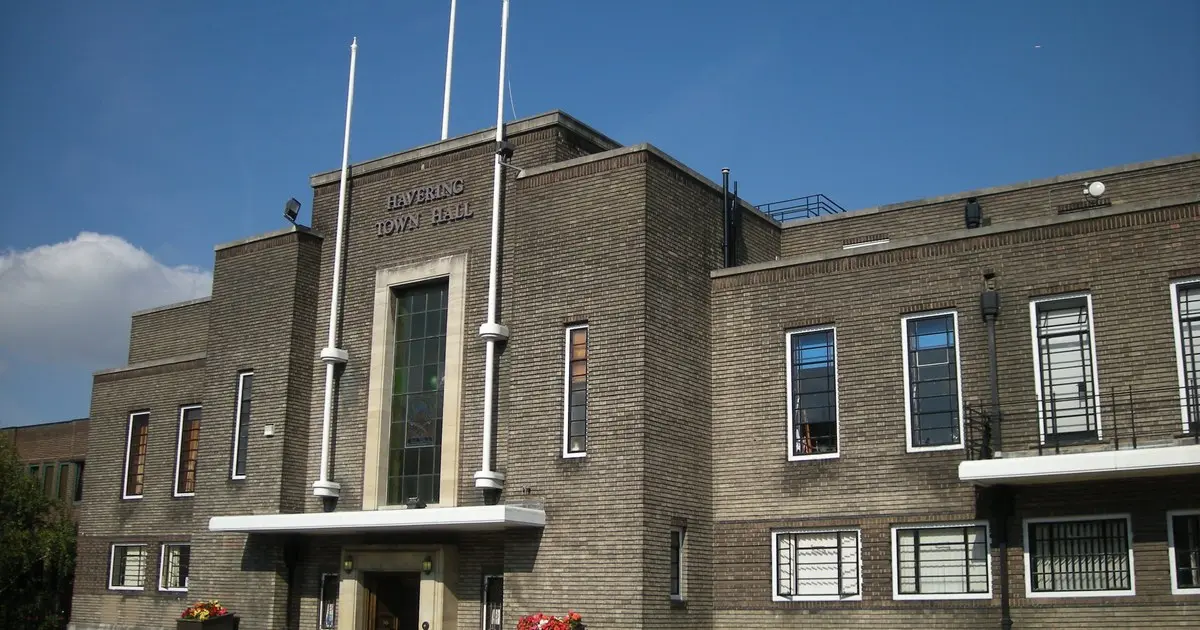
Havering Town Hall, Romford (Fay1982, CC BY-SA 3.0, via Wikimedia Commons).
More than 20 formal complaints have been filed against Havering councillors over the past 18 months, a new council report has revealed — ranging from allegations of racism and disparaging emails to rude gestures at a church service and the removal of political posters.
The official report, published by Havering Council and dated 22 October, shows that 21 formal complaints involving 24 councillors were lodged between 1 April 2025 and 1 October 2026. Four of the complaints involved councillors elected after the May local elections, when Reform UK secured control of the town hall.
The grievances covered an unusually wide spread of behaviour. They included allegations of racism, heated arguments on social media, disparaging emails, failing to respond to constituents, the improper handling of a neighbourly dispute, rude gestures at a church service, and councillors removing political posters.
Apologies ordered in four cases
Investigations by the council’s monitoring officers led to formal apologies being ordered in four cases. One concerned a scrutiny committee meeting in July 2025; another involved a councillor identified only as “Cllr K”, who removed political posters in August 2025 and was ordered to apologise in February this year.
A third followed an incident on 25 November 2025 in which a councillor made rude gestures at a church service, while a fourth — involving shouting and corruption accusations by “Cllr P” on 26 November — also resulted in an apology requirement, issued in January 2026.
Two complaints remain under active investigation: one concerning “Cllr W” over remarks on social media, and another concerning “Cllr X” over alleged direct involvement in an “operational matter”.
What happens when a councillor is complained about
Complaints against councillors in England are assessed under the Councillors’ Code of Conduct, which Havering — like every local authority — is required to maintain. Allegations are typically reviewed by the council’s monitoring officer, who can decide no action is needed, seek an informal resolution, or refer the matter for a formal investigation. Sanctions are limited: a council cannot suspend or disbar a member, but it can require a public apology, remove them from committees, or publish its findings.
The fact that names are withheld — councillors identified only by letter — is standard practice. Standards reports are routinely anonymised to protect both complainants and the subject of complaints, particularly where investigations are ongoing.
A politically charged backdrop
The complaints period straddles one of the most turbulent political periods in Havering’s recent history. The May 2026 local elections saw Reform UK take control of the town hall, reshaping the borough’s political landscape — and four of the 21 complaints involve councillors elected in that wave.
Council leader Keith Prince said: “We take these matters extremely seriously and where there were complaints against councillors, they were handled in line with the Councillors’ Code of Conduct and related complaints procedure.”
Conduct complaints are a recurring feature of local government in the capital. The figures follow a difficult year for town halls across London, where Westminster Council is cutting 520 roles to save £29 million, and boroughs such as Romford are cracking down on rogue landlords amid stretched budgets.