


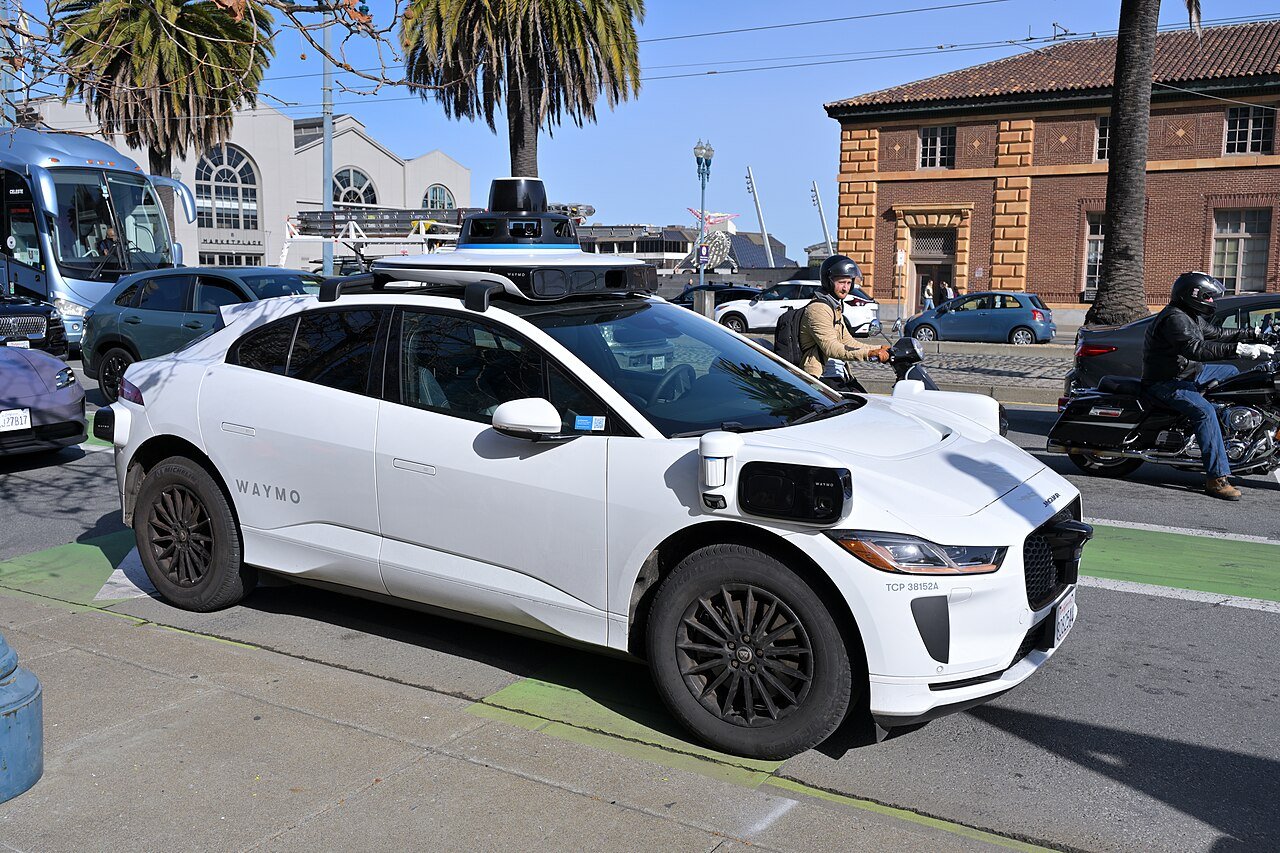
Keep your eyes on the road on the morning commute — some Londoners have started spotting something unusual in traffic: a white Jaguar I-PACE bristling with cameras and crowned with a spinning sensor pod, seemingly driving itself through the capital’s streets.
The cars belong to Waymo, the self-driving technology company owned by Google’s parent Alphabet, which has quietly begun running its autonomous vehicles on London’s roads. The firm is carrying out mapping and safety-validation work across a string of boroughs — Lewisham, Southwark, Lambeth, Wandsworth, Camden, Westminster, Hackney, Newham, Tower Hamlets and Greenwich — ahead of a planned driverless taxi service in the capital.
Before anyone rushes to hail one, there is a catch: the current runs are not commercial passenger journeys. Every car still carries a trained autonomous specialist in the driver’s seat, monitoring the system as Waymo puts its technology through its paces on some of Europe’s most demanding urban roads.
What is Waymo?
Waymo began life as Google’s self-driving car project back in 2009, before being spun out as a standalone company under Alphabet in 2016. Its core business is a ride-hailing service with a twist: instead of a driver in the front seat, the car’s automated driving system — known as the Waymo Driver — controls the entire journey. Passengers request a car through the Waymo app, much like booking a conventional taxi or private-hire vehicle, then climb into the back of a car with an empty driver’s seat.
The company already operates a commercial driverless service in parts of the United States, and London is its big bet for bringing the technology to Europe.
How do the cars drive themselves?
The Waymo Driver blends artificial intelligence with an array of hardware: cameras, radar and lidar. Lidar fires rapid laser pulses to measure distances, building a detailed three-dimensional picture of everything around the car. Together, the sensors give the vehicle a 360-degree view, allowing it to pick out pedestrians stepping off kerbs, cyclists filtering through traffic, traffic lights and other vehicles.
That flood of information is processed by onboard software, which works out precisely where the car is, what is happening around it, what other road users are likely to do next — and how it should respond. The system then handles the steering, braking, acceleration and positioning on the road itself.
Before operating anywhere new, Waymo also builds painstakingly detailed maps of the area — which is a large part of what the London test cars are doing right now.
Why London, and why now?
London’s roads are famously unforgiving: medieval street patterns, endless roadworks, double-decker buses, black cabs, delivery riders and tourists wandering into cycle lanes. For an autonomous-driving company, that chaos is the point. If the Waymo Driver can cope with a rainy rush hour on the Old Kent Road, it can cope with just about anything.
The capital is no stranger to driverless experiments — Greenwich hosted some of Britain’s earliest self-driving shuttle trials nearly a decade ago — but Waymo’s arrival marks the first time a company already running a full commercial robotaxi service abroad has set its sights on London.
The timing matters too. Parliament passed the Automated Vehicles Act in 2024, creating a legal framework for self-driving vehicles in Britain, and a new Automated Passenger Services permitting system will govern driverless taxi operations. Under that regime, Waymo needs national approval as well as consent from Transport for London before it can carry paying passengers with nobody behind the wheel.
City Hall has been examining the prospect closely, weighing the potential road-safety benefits against the impact on other road users — and on London’s existing taxi and private-hire trades. Black-cab drivers, already warning of a cab shortage as the trade battles rising costs, will be watching the robotaxi experiment with understandable interest.
Waymo said in September that it was working to secure the approvals needed to operate its service, and it is preparing its London operation with fleet partner Moove.
What it could mean for getting around the capital
A driverless taxi network would land in a city whose transport system is already under strain. London’s buses are already crawling at their slowest speeds in more than a decade, and the arrival of robotaxis raises big questions: will they ease congestion by running efficiently around the clock, or add thousands more vehicles to crowded streets?
Supporters argue that autonomous vehicles could cut collisions caused by human error and offer a lifeline late at night when public transport thins out. Critics counter that the technology is unproven on London’s chaotic roads, and that driverless cars could undercut the livelihoods of tens of thousands of taxi and private-hire drivers.
Either way, the sight of sensor-topped Jaguars quietly mapping the capital suggests the debate is about to get very real — just as London keeps reshaping its transport network, from proposed new Overground links to the expansion of driverless technology itself.
Spotted one? Here’s what to look for
The London test fleet uses specially equipped Jaguar I-PACE electric cars. Eagle-eyed spotters may notice something odd: some of the Jaguars are left-hand drive, because they were originally built for Waymo’s American operations. Waymo says the steering wheel’s position makes no difference, since it is the Waymo Driver — not a person — that ultimately controls the car.
For now, Londoners cannot book a commercial Waymo journey. The company says people can register their interest through its app to be told when the service becomes available in their area.
What happens next
Waymo has said it intends to bring driverless taxis to London in 2026, though that ambition hinges on regulatory approval. Until then, the sensor-topped Jaguars will keep mapping the capital’s streets — a curious sight today, and perhaps just another part of the London commute before long.