



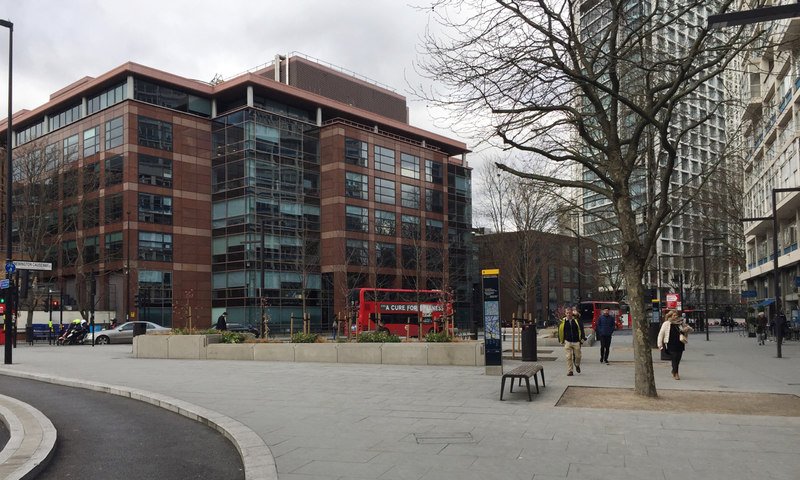
Southwark Council’s planning committee has unanimously refused a request from Berkeley Homes to slash the number of affordable homes at its major Borough Triangle development in Elephant and Castle, in what councillors framed as a defence of the borough’s housing commitments.
The housebuilder had asked to vary its existing planning permission so that the guaranteed on-site affordable housing across the 892-flat scheme would fall from 230 homes to just 60 — dropping the affordable share from 35 per cent to 10 per cent. The committee rejected the application outright.
The decision, taken on 14 September, leaves the original, higher affordable housing commitment intact — at least for now. Berkeley Homes had already lodged an appeal with the Planning Inspectorate on the grounds that the council failed to determine the application within the statutory timeframe, meaning the final outcome of the row could yet be decided outside Southwark.
What the council decided
Under the Section 73 application, Berkeley sought to change a condition attached to the existing consent for the Borough Triangle site off Newington Causeway without submitting an entirely new planning application. The physical scheme — four tower blocks rising up to 44 storeys, with commercial space, offices, a public piazza and room for community uses and a food hall — would have remained unchanged.
What would have changed was the tenure mix. Just 60 of the 892 flats would have been affordable: 42 social rented homes and 18 intermediate tenure units. Planning officers noted that, although independent viability reviews accepted Berkeley was facing genuine financial deficits under current costs, 10 per cent affordable housing did not deliver enough public benefit to outweigh the identified harm to nearby heritage assets, including the adjacent Trinity Church Square Conservation Area.
Officers cannot lawfully refuse a viability-tested application on financial grounds alone where a deficit is verified, so the refusal was framed around the statutory planning balance: whether the heavily diminished public benefits justified the preserved scale and heritage impact of the 44-storey structures. The committee agreed with the recommendation and voted unanimously to refuse.
Addressing the committee, ward councillor David Watson called the proposed cut “a slap in the face” for local families, pointing to Southwark’s housing waiting list of around 23,000 households. Liberal Democrat opposition leader Victor Chamberlain, whose comments were reported by the South London Press, had previously said that cutting affordable provision on a site delivering nearly 900 homes was “simply unacceptable” and risked undermining public trust in the borough’s planning system.
The developer’s case
Berkeley Homes maintained that the economics of building high-density towers in Zone 1 London had changed radically since the scheme was first designed. In statements given to the Local Democracy Reporting Service, a company spokesperson said:
“The reality is that each affordable home is built at a major financial loss, so developments can’t deliver as many now that taxes, planning levies, regulations and build costs have all increased. This is why new private and affordable homebuilding has fallen to record lows across London.”
The developer pointed to sustained inflation in labour and building materials, flatlining private sale values, slower absorption rates, and updated national building safety rules — notably the requirement for secondary staircases in residential buildings over 18 metres, introduced following the Grenfell Tower inquiry. Berkeley’s financial viability assessment argued that keeping the original 35 per cent quota rendered the project wholly unviable, and that 10 per cent was the only “tenable option” to get it built.
The company added that the 10 per cent figure was a baseline assuming purely private funding, and that it aimed to reach 20 per cent overall if it could secure public subsidy through grant programmes run by the Greater London Authority and central government.
A long-running regeneration row
The Borough Triangle site, between Newington Causeway and Borough High Street, has been one of the key brownfield parcels in the Elephant and Castle regeneration corridor for more than a decade. Formerly commercial warehousing and light industrial units — including the site of the popular Mercato Metropolitano food hall — it was earmarked by the council for high-density housing, jobs and public realm improvements.
Berkeley Homes, working with architects Maccreanor Lavington, submitted its original application in 2024 for 892 build-to-rent and private-sale flats. The 2025 approval was contentious: campaigners, including the 35% Campaign, objected over density, overshadowing and gentrification, and 415 of the 434 consultation responses were formal objections. Councillors approved the scheme by a narrow four-to-three margin, relying on the commitment to deliver 35 per cent affordable housing on site.
The refusal is not the first planning friction between Berkeley and Southwark. The developer’s non-determination appeal over Borough Triangle follows a wider pattern, including recent legal proceedings over the council’s refusal of the 850-home Aylesham Centre redevelopment in Peckham.
What happens next
With a non-determination appeal already before the Planning Inspectorate, the Borough Triangle row may be resolved by a national inspector rather than at Tooley Street. In the meantime, the original consent stands — but Berkeley has argued it cannot viably build under those terms, which raises the prospect of the site sitting undeveloped while the process plays out.
That uncertainty is already being felt on the ground. Mercato Metropolitano continues to operate from the site under temporary arrangements, and Latin American community organisations earmarked for space in the new commercial floors face an unclear timetable. For the thousands of households on Southwark’s housing register, the committee’s decision defends the principle of developer contributions — but does not, by itself, put a single new home any closer to being built.