


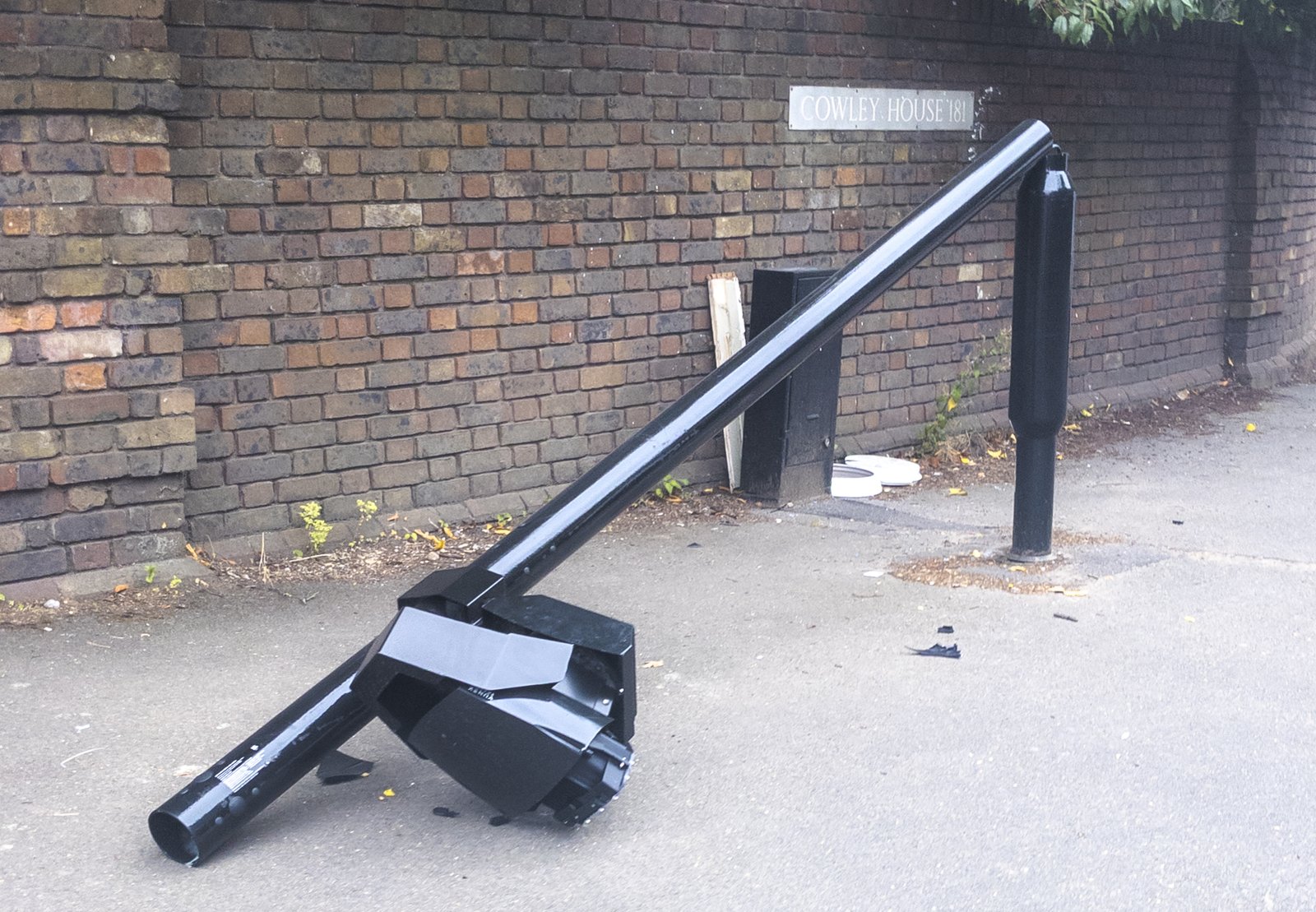
A 63-year-old man who blew up a ULEZ enforcement camera with a homemade bomb has been jailed for 15 years, after a judge ruled the attack was carried out with a “terrorism connection”.
Kevin Rees, from Sidcup in south-east London, was sentenced at the Old Bailey on Friday after a jury convicted him of causing an explosion likely to endanger life. The court heard he fashioned a device from a metal cylinder packed with explosive powder and set it off beside the roadside camera in December 2023.
The blast, shortly after 6.20pm on 6 December 2023, scattered shrapnel and debris across more than 100 metres, damaging parked cars and nearby homes — including the window frame of a child’s bedroom. Detectives said it was “miraculous” that nobody was killed or badly hurt.
A jury at Woolwich Crown Court heard that Rees drove his Smart car from his Sidcup home to Shuttle Close that evening. The camera had been put up only that day and — in a wholly separate incident — had already been cut down by another individual, who was separately traced and convicted by the same team of detectives.
Rees covered the short distance from his car to the camera on foot, planted the device, lit the fuse and was spotted by a witness walking briskly away from the scene in the moments before the detonation.
The explosion wrecked a van parked opposite and blew out the tyre of another car. Shrapnel tore through a passing vehicle and lodged in the base of a passenger seat, while a garden wall, front porch, shed and Wendy house were also damaged. A chunk of metal was flung more than 100 metres into a child’s bedroom window frame. Against the odds, no one was hurt.
CCTV from a bus travelling along the road at the time showed it escaping the hail of debris by a matter of seconds, police said.
Forensic scientists who examined what remained of the device established that black powder had been used to power the blast. Rees was arrested by Counter Terrorism Policing London officers on 18 December 2023, and his home was searched.
Inside, officers recovered a sealed postal package addressed to Rees and filled with aluminium powder, plus a plastic bag containing iron oxide — two substances that can be combined into low-explosive mixtures. Other items found in his loft suggested a sustained interest in chemicals capable of being turned into explosives.
Detectives also trawled through Rees’s social media and discovered he had posted repeatedly about ULEZ cameras, urging others to damage them. His phone held a photograph, taken on 6 December, showing the camera in Willersley Avenue being installed — deleted the next day — along with screenshots of Facebook posts about the explosion and a picture of Willersley Avenue taken after the blast, with emergency services in attendance. He wiped all of them on 8 December.
Officers additionally found three homemade stun guns at the property. The jury found him guilty of three counts of possessing a prohibited weapon, drawing a three-year sentence to run alongside the main term.
At the sentencing hearing, the judge found the bombing had a “terrorism connection” and imposed 15 years’ imprisonment for the explosion offence, while paying tribute to the investigation team in his remarks.
Detective Chief Superintendent James Derham, who leads local policing in the Bexley area, said: “It was miraculous that nobody was killed or seriously injured in the large explosion caused by Rees. He showed a complete disregard for the welfare and safety of the people who live in, or were travelling through, the area at the time of the explosion — all because he was unhappy with the ULEZ scheme.”
“The conviction and sentencing have been possible due to the commitment and professionalism of our CTP London detectives, supported by our frontline policing colleagues in Bexley,” he added. “I’d like to thank the local community for their support and understanding while we responded and investigated this incident, and I hope this sends a very strong message of the dangers and consequences of using home-made explosives.”
“Damage of any kind is completely unacceptable, and this particular incident demonstrates the very serious consequences for those responsible when taken to this extreme.”
The case marks the gravest escalation so far in the running battle over ULEZ enforcement cameras. Since the zone was stretched to cover all London boroughs in August 2023, the cameras have become a magnet for anger, with devices across outer London sawn down, daubed with paint and stolen, and clips of the vandalism shared and celebrated online. Until now the attacks have largely been dealt with as criminal damage — the Rees prosecution shows how far beyond that boundary one opponent was willing to go.
The judge’s finding of a “terrorism connection” carries real weight. Where a court concludes an offence is linked to terrorism — typically grave violence meant to advance a political or ideological cause — its sentencing powers grow significantly. Causing an explosion likely to endanger life is among the most serious crimes on the statute book, punishable by up to life imprisonment. The 15-year term handed to Rees ranks among the stiffest passed in London this year, alongside the 16-year sentence given to arms broker David Greenhalgh.
It is the latest major conviction secured by the Metropolitan Police, whose Counter Terrorism Policing detectives led the investigation — following the jailing of former officer Kuldip Singh over a “crash for cash” insurance fraud.