


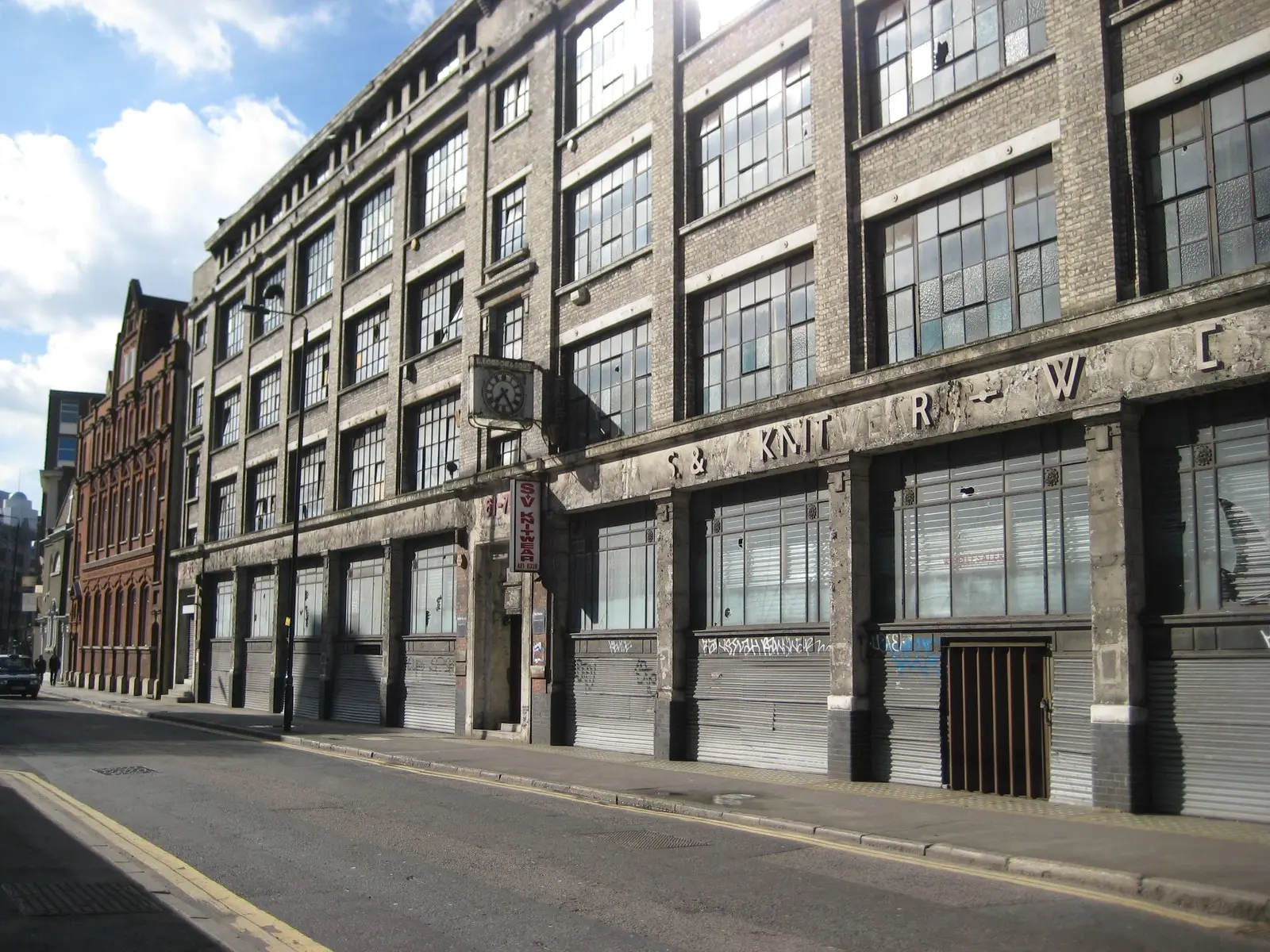
A documentary photographer has shared a rare glimpse inside a closed Wanstead factory in its final days, capturing the silent machines of a family engineering business that spanned three generations.
Russell Boyce has just published his latest story, ‘Essex Engineering & Coin-Op Controls Ltd’ — a photographic record of the Wanstead factory owned by 88-year-old Ken Allen. The film of the story was first shown at a sell-out event at the Wanstead Curtain as part of the Wanstead Fringe.
Russell had long wondered what went on behind the factory doors — and his curiosity got the better of him. ‘For years I walked past the factory doors and wondered, what are coin-op controls? So, one day I decided I’d knock on the door and ask.’
Ken invited him in and gave him a tour. Alongside the magnificent machines, he revealed a family history stretching back three generations to his family’s arrival in London from rural Italy.
From a card game to an engineering firm
His grandfather reputedly won a café in a game of cards — a café containing a one-armed bandit. As the café business grew, he ended up owning 50 one-armed bandits that all needed maintaining.
In 1935 the family opened a repair workshop, soon expanding into a mechanical engineering firm under a railway arch in Leyton. In 1940 they moved to Wanstead to escape the bombing raids, founding Essex Engineering (Wanstead) Ltd.
During the war, production served the war effort with metal stampings for the Ministry of Defence. Ken recalled: ‘I remember as a boy of five being seated at a hand press with a box of metal plate blanks and forming up the triggers for the Sten gun.’
After the war, Ken’s father sank everything — home and furniture included — into a small inexpensive sewing machine. It was a huge success: by 1956, 200,000 had sold in every UK department store, even Harrods, at £3.17.6 — about £3.87 today.
The success sent Ken to Imperial College, where he found a passion for theoretical physics. But his father died in 1959, and the 21-year-old took over a struggling business after larger sewing machines proved a financial disaster.
The coin-op boom — and the end of an era
Copper clips and terminating tools for fireproof cable, taken on in 1948, boomed as the sewing machine trade died. In 1961, working with a firm importing washing machines from Sweden, Essex Engineering began making coin-operated washing machine controls.
The turning point came with 1971 decimalisation: a mechanism bridged old and new coins, and rapid 1970s inflation meant coin slots needed constant updating. As coin-operated pool tables boomed, Essex Engineering sold 750,000 units by 1990 and built a strong export business.
But electronics and digitisation slowed the business, and in September 2025 Ken finally closed the doors. It is those majestic silent machines — and the personal touches of abandoned workstations, with their feel of the Marie Celeste — that drew Russell’s lens.
Russell’s photographs add to a growing record of the capital’s industrial heritage, as such landmarks remain under threat — the fire that gutted the Ecclefechan heritage landmark in Addiscombe showed how quickly they can be lost, while a £247,788 lottery grant is restoring a rare 1861 organ in a Hammersmith school chapel.
You can see the full story on his YouTube channel, RussellBoycePhotographer, or on his website, russellboyce.com.